When and how available
| the moon | Accessibility |
|---|---|
| January — May | ❌ Not the season |
| June — July | ✅ The peak is the only flowering season, 2-3 weeks |
| August | ❌ Flowering is complete |
| September — December | ❌ Not the season |
Linden is one of the most striking examples of a hyperseasonal ingredient: only 2-3 weeks a year. City farms do not grow linden — it is exclusively a field crop. After picking, the flowers are dried for year-round use in teas and syrups.
| Form | Features of use |
|---|---|
| fresh | The maximum aroma, the term is only 1 day; a rarity even in season |
| dry | The basic form preserves the aroma for months, a classic for teas |
| Syrup | Lime syrup for desserts, cocktails, ice cream; cooked in season |
| Infused honey | Fresh flowers are infused in warm honey — a floral escalation of aroma |
| Kandovan | For confectionery decoration - less often than with other flowers, but possible |
Taste, aroma & texture
Gentle, honey-sweet with a distinct vanilla-floral note. The flowers themselves have a very delicate taste - the main value is not in the taste, but in the aroma that they impart to drinks or dishes. A fresh flower is slightly juicy, with sweet nectar; the dried one opens up during brewing into a full honey-floral aroma.
One of the most intense and recognizable aromas among all edible flowers. Honey-vanilla, warm, enveloping - thanks to it, linden tea is a symbol of home comfort in Ukraine and most of Europe. When flowering, the aroma of the tree can be felt for dozens of meters. The aroma is preserved after drying and is even partially transmitted through syrup and infusion into honey.
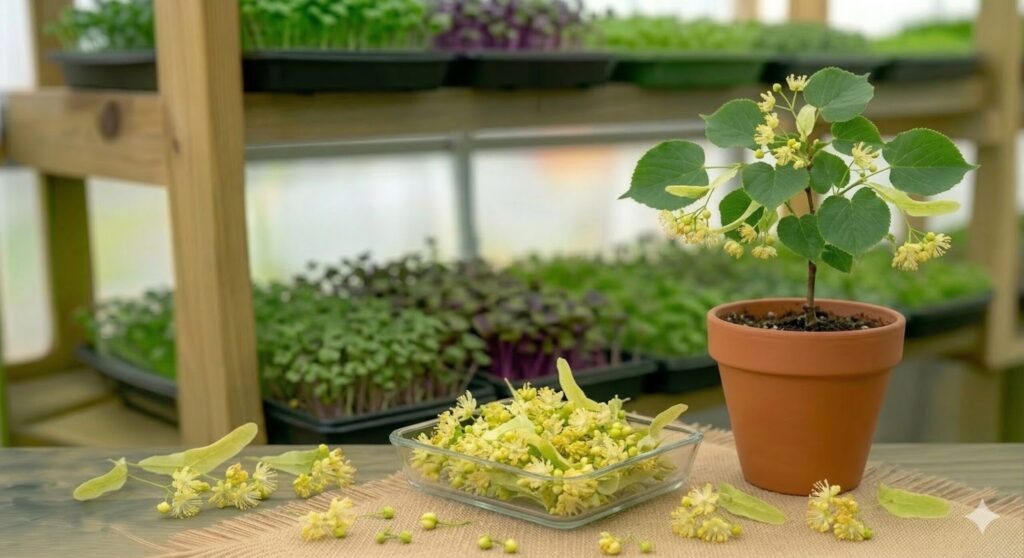
The inflorescence consists of 5–15 small creamy-yellow flowers on a common peduncle attached to a characteristic pale green elongated bract (bracte). The flowers themselves are extremely delicate and soft - they dissolve almost immediately. The bract is slightly tougher, but also edible. It is this pair - flowers plus bracteum - that is what is depicted on packages of linden tea and that is collected from the tree as a whole "bouquet".
Safety & edibility
Edible flowers are not the same as florist flowers. Only flowers grown specifically for food use without synthetic pesticides are suitable.
- ✅ Flowers with a bract (bractea) are the main edible part
- ✅ Young leaves - in small quantities, have a neutral taste
- ❌ The bark is not edible
- ❌ Seeds - contain neurotoxic compounds in large quantities; not used in culinary use
Are all types edible: Main culinary types — Tilia cordata and Tilia platyphyllos. Both are safe in dietary amounts. Not to be confused with fruits and seeds - they are not eaten.
Heat treatment: For syrups and infusions, short-term heating (not boiling) is acceptable and necessary. Boiling tea destroys some of the aromatic substances — traditionally, linden tea is brewed with water at 80–85°C. Fresh flowers for decoration - without heat treatment.
- In food amounts (tea, syrup, decor) linden is safe for most people
- To people from cardiovascular diseases it is not recommended to use linden tea in large therapeutic doses (more than 3-4 mugs per day) - only in moderate, culinary quantities
- Moderate use by pregnant women
- An allergy to linden pollen (and, less often, to flowers) is possible in people with a pollen allergy
This information is general in nature and is not medical advice. Sources: USDA FoodData Central, EFSA.
Culinary use
Linden is a flavoring flower. Unlike nasturtium or borage, where the taste of the flower is part of the dish, linden is primarily flavored: through infusion in cream, syrup, honey or tea. Fresh flowers are used as a delicate decoration in desserts and drinks. Dried linden is one of the most popular ingredients in confectionery products with a floral aroma.
Infusion in cream (cold method)
fresh or dried linden blossoms are placed in cold cream or milk and infused for 4–8 hours in the refrigerator. Filtered. The result is cream with a deep honey-vanilla flavor for panna cotta, ice cream, and cream.
Preparation of syrup
the inflorescences are brought to 70–80°C together with sugar syrup, infused for 30–60 min and filtered. Do not boil - high temperature destroys some of the aromatic essential oils. Ready syrup is stored in the refrigerator for up to 3 weeks.
Drying
the basic and simplest technique. Inflorescences are dried in the shade or at 30–40°C. Dried linden preserves its aroma for up to 2 years in an airtight container. The main rule: dry the inflorescence itself together with the bracteia - this is how the flowers retain their structure.
Candy making
possible, but less often practiced than with more "decorative" flowers. Separate flowers or small inflorescences are covered with egg white and fine sugar. Suitable for decorating cakes and pastries.
Freezing in ice
a whole inflorescence in a mold for ice cubes; pale yellow linden flowers retain their color and shape after freezing; spectacular decor in summer drinks.
Infusion in honey
fresh or dry linden flowers in liquid honey for 2–4 weeks; honey acquires a delicate floral aroma; a classic combination — linden honey and flowers together.
- Do not boil linden when brewing tea or preparing an infusion — boiling destroys part of the aromatic essential oils; the optimal temperature is 80–85°C
- Do not miss the season - the linden blooms for only 2-3 weeks; if fresh flowers are needed, plan ahead or freeze in season
- Do not pick flowers in cities near roads or in parks without a guarantee of the absence of pesticides and car emissions - look for a certified supplier or go out of town
- Do not use linden seeds in cooking - unlike flowers and leaves, they are not intended for food use
Perfect pairings
linden honey, honey desserts, honey makers — a natural union: bees collect nectar from linden trees, and this synergy in cooking is obvious. Flowers in honey strengthen and deepen the honey aroma.
classic tea with linden and lemon, lemon tarts with linden cream, citrus sorbets with linden syrup - the acid of citrus perfectly shades the honey-floral sweetness of linden.
panna cotta, crème brûlée, ice cream, creamy mousse - the warm vanilla-floral aroma of linden organically fits into creamy desserts, adding floral complexity without harshness.
blend of linden, chamomile and mint - a classic soothing mixture; in cooking, this tandem is used for aromatic creams and syrups.
prosecco, sauvignon blanc, gin and tonic with linden syrup - the floral aroma of linden does not interrupt the subtle grape notes, but elegantly complements them.
cod, flounder, trout - linden goes well with fish dishes due to its tenderness and lack of pronounced bitterness; linden syrup or infusion in the sauce gives an unexpected floral accent.
How to select & store
- Inflorescence with bracteia is complete, flowers are creamy yellow, without darkening
- The aroma is strong and clean, honey-floral - the aroma itself is the main quality criterion
- The bract (green bract) is fresh, elastic, without yellowing
- No traces of moisture, mold or insects
Where to buy is important: Linden is one of the few edible flowers where wild harvesting is traditional and acceptable - but only away from roads and industrial areas, and only when you are sure of no cultivation. In a culinary context, it is better to buy from a proven supplier.
Freshness after cutting: 2–3 days
- Fresh flowers are extremely delicate; stored only for 1 day; use or dry immediately after collection or delivery
- Dried flowers - sealed glass or metal jar, dark dry place; keep the aroma for up to 2 years
- Lime syrup — refrigerator, airtight bottle, up to 3 weeks
Composition & properties
Linden has long been known as a medicinal plant, and modern research confirms the presence of significant biologically active compounds in the flowers. The main value is flavonoids and essential oils, which determine both the aroma and the properties of linden blossom.
| Nutrient | Value (per 100 g of fresh flowers) |
|---|---|
| Caloric content | ~20–35 kcal |
| Flavonoids (quercetin, kaempferol) | ~1–3% of dry weight |
| Essential oils (farnesol, geraniol) | ~0.02–0.05% of raw mass |
| Vitamin C | ~10–20 mg |
| Mucous substances | ~3–6% of dry weight |
| Phytoncides | are present |
Linden is an officially recognized medicinal plant in Ukraine and most countries of the European Union — in particular, in the Europäisches Arzneibuch (European Pharmacopoeia). The flavonoids quercetin and kaempferol are studied in the context of antioxidant properties. Essential oils of linden contain farnesol and geraniol - they form a characteristic floral aroma, which is preserved even in dried form. Mucous substances in flowers soften and have protective properties - this is why linden is traditionally used for colds.
The information is general in nature and does not constitute medical advice. Composition data: USDA FoodData Central.