When and how available
| the moon | Accessibility |
|---|---|
| January — February | ❌ Not the season |
| March — April | ✅ The peak is the main flowering season |
| May | ✅ Completion, single flowers |
| June — August | ❌ Summer calm |
| September — October | ✅ Frequent re-blooming |
| November — December | ❌ Not the season |
The forest violet blooms twice: in spring (the main season) and often a second time in autumn. City farms can provide a year-round supply in a closed environment.
| Form | Features of use |
|---|---|
| fresh | For salads and living decorations, the term is 2–3 days |
| Kandovan | A confectionary classic — keeps its shape and color for months |
| Syrup | Syrup de violette — aromatic purple syrup for cocktails and desserts |
| dry | For tea and infusions |
| Violet sugar | Petals are rubbed with sugar - an aromatic seasoning |
Taste, aroma & texture
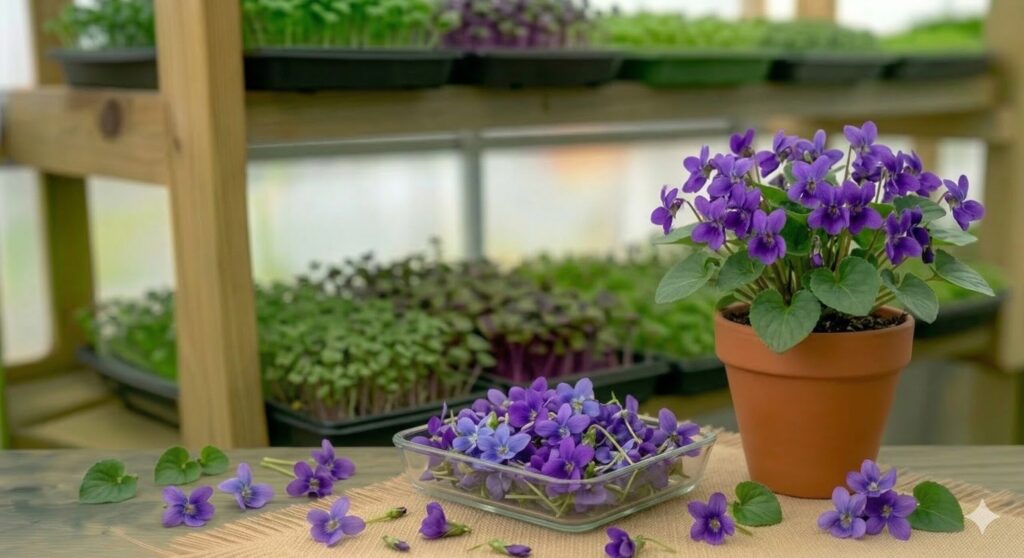
Pronounced, floral-sweet with a characteristic "perfume" shade, which is not found in any other edible flower. Slightly powdery finish. More intense than pangas (*Viola* hybrids), *Viola odorata* is the aromatic species. Young leaves are more tender, herbaceous and floral.
One of the most intense edible flowers. The classic "violet" smell used in perfumery is ionones (aromatic compounds) that create a characteristic sweet-powdery aroma. An interesting phenomenon: after the first inhalation, the receptors are temporarily "disabled" and the aroma disappears, only to reappear after a few seconds.
Five asymmetric petals, delicate and velvety. Very thin, melt on contact. The lower petal is wider - it gives a characteristic silhouette that looks so good after canding. ---
Safety & edibility
Edible flowers are not the same as florist flowers. Only flowers grown specifically for food use without synthetic pesticides are suitable.
- ✅ Flowers and petals
- ✅ Young leaves - in salads, soups, for thickening
- ❌ Roots and seeds - contain alkaloids, do not consume in large quantities
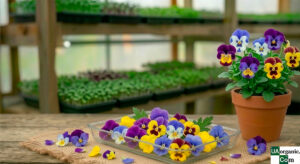
The difference between the species: Edible and aromatic - Viola odorata (fragrant / forest violet). Panzi (Viola × wittrockiana) are also edible, but have almost no aroma. Most wild violets are edible, but Viola odorata — the only one with a pronounced taste and aroma for cooking.
- Roots and seeds contain alkaloids - do not use
- When using for the first time, start with a small amount
- Moderate consumption for pregnant women
This information is general in nature and is not medical advice. Sources: USDA FoodData Central, EFSA.
Culinary use
Forest violet is a rare case when the floral aroma is so pronounced that the flower becomes a full-fledged flavor ingredient. Syrup de violette is the basis of classic French cocktails; candied violets are an icon of Victorian and modern confectionery; violet sugar is an elegant seasoning for desserts.
Candy making
the most important technique for violets. Petals or whole flowers are carefully covered with a thin layer of beaten egg white, sprinkled with fine sugar and dried at 40°C for 3–4 hours. A properly candied violet keeps its color and shape for 6–12 months.
Syrup de violette
Pour 200 ml of boiling water over 100 g of fresh flowers, infuse for 24 hours, filter, add 200 g of sugar and 1 tsp. lemon juice (to stabilize the color). Store in the refrigerator for 1 month.
Violet sugar
fresh petals are ground with powdered sugar (1:5 by volume), spread in a thin layer on parchment and dried at room temperature for 24 hours. Store in an airtight jar for 3-6 months.
Freezing
flowers are frozen in ice cubes for cocktails; the color is preserved well.
Fresh decor
fragrant violet flowers are placed on a dish or dessert immediately before serving; gentle purple-blue color looks good on cream and chocolate backgrounds.
Infusion in water or milk
violet flowers in cold water or milk for 2–4 hours; the liquid acquires a delicate purple-pink shade and a floral aroma; for panna cotta and floral drinks.
- Do not confuse with Panzi (Viola hybrids) - they are also edible, but practically without aroma; forest violet is the only one with a pronounced taste
- Do not use the roots and seeds - they contain alkaloids
- Do not heat fresh flowers - the aroma disappears instantly; add to cold dishes or finishing
- Do not wash under a stream - the delicate petals are deformed; careful immersion and drying on a towel
Perfect pairings
Chocolate, raspberries, cakes - dark and milk chocolate - a classic pair with violet; the floral-powdery aroma contrasts with the bitterness of chocolate used in premium candies and cakes.
Mascarpone, mousse, cream — a delicate creamy base emphasizes the floral aroma without competition; basis for mousses, creams and parfaits.
Lemon, bergamot, sorbet - citrus acidity "raises" the violet aroma and makes it brighter; base for sophisticated sorbets and lemonades.
Aviation, Violette Royale — classic recipes with syrup de violette; fresh or candied flowers as decoration.
salty savory goat cheese and sweet-floral violet aroma - a classic French combination in tartlets, bruschetta and appetizers.
violet syrup in Earl Gray or in floral tea mixtures; a traditional combination — Victorian Britain and a modern French pastry shop.
How to select & store
- The petals are elastic, deep purple or white (in white varieties)
- The aroma is pronounced - if it doesn't smell, it's not Viola odorata
- Without wilting and brown spots
- The center of the flower is dry
Where to buy is important: Buy only from proven producers, grown specifically for the food industry. Flowers from flower shops and markets not suitable for consumption — treated with pesticides. The spring season is very short - book in advance.
Freshness after cutting: 2–3 days
- Fresh flowers — airtight container with a paper towel, refrigerator +4...+6°C, term 2–3 days
- Do not wash before use - moisture accelerates wilting
- For long-term storage — candiing (best), syrup or drying
Composition & properties
Forest violet contains ionones — unique aromatic compounds responsible for its characteristic smell. These same compounds are used in perfumery and the food industry as a natural flavoring agent.
| Nutrient | Value (per 100 g of fresh flowers) |
|---|---|
| Caloric content | ~20–35 kcal |
| Vitamin C | ~150–200 mg is a record high |
| Vitamin A (beta-carotene) | ~0.5–1.5 mg |
| Flavonoids (rutin, quercetin) | ~0.5–2% of dry weight |
| Anthocyanins | ~20–80 mg/100 g — purple color |
| Ionones (α- and β-ionone) | ~0.01–0.05% of the raw mass is a characteristic aroma |
| Mucous polysaccharides | ~2–5% of dry weight |
Wild violet is one of the record holders for vitamin C content among edible flowers — on average 150–200 mg per 100 g, which is more than lemon. Rutin and quercetin are the subject of scientific research on strengthening blood vessels. Ionones are natural aromatic compounds that are used not only in cooking, but also in perfumery and cosmetics.
The information is general in nature and does not constitute medical advice. Composition data: USDA FoodData Central.