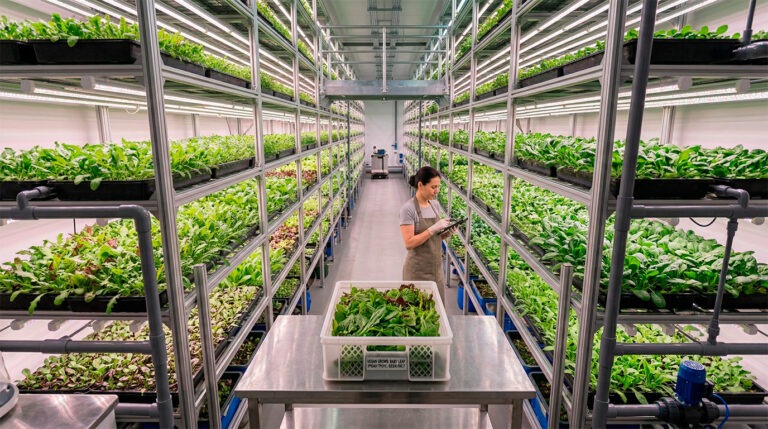
Hydroponic basil reaches a saleable cut about three weeks after transplant, as long as the greenhouse is warm. At 72°F (22°C), a sweet basil plant needs 22 days to reach 22 g, the weight of a marketable shoot. At 64°F (18°C), the same shoot takes 36 days. That estimate comes from a model in Kellie Walters’s master’s thesis at Iowa State University (advisor Christopher Currey, 2015), where basil was grown in hydroponic greenhouses and growth chambers.
The same research gives a second number: cultivar matters more than the system. Across 35 cultivars, sweet basil put on anywhere from 15 to 51 g per plant in three weeks, while the difference between NFT and deep flow was 2.6 g. Below we go through what that means in the greenhouse: heat, system, cultivar, nutrient solution and spacing, downy mildew, and storage after harvest. The basic agronomy of the crop (day and night temperatures, EC, VPD, light, flowering) is in the wiki entry basil and aromatic herbs, so we don’t repeat it here.
Basil and temperature: days to harvest
In growth chambers, basil was held for three weeks at 52, 63, 73, 84, and 95°F (11, 17, 23, 29, and 35°C). Growth increased up to 84°F (29°C) and dropped between 84 and 95°F. The base temperature, below which growth stops, came out at 51.6-53.8°F (10.9-12.1°C) depending on species. For comparison, cold-tolerant crops have a base temperature below 39°F (4°C). The thesis classifies basil as cold-sensitive and heat-tolerant.
| Air temperature | Days to a 22 g shoot |
|---|---|
| 64°F (18°C) | 36 |
| 68°F (20°C) | 27 |
| 72°F (22°C) | 22 |
The model is for sweet basil ‘Nufar’. In a winter greenhouse, this is a money question: every extra 4°F (2°C) costs gas or electricity but cuts 5-9 days off the cycle. The thesis says as much: growers should run their own cost-benefit analysis to find the most profitable temperature. Node appearance tells the same story: 0.03 new nodes per day at 52°F (11°C) versus 0.3 at 84°F (29°C), ten times faster.
Heat hurts basil less than cold. Even at 95°F (35°C) it kept growing, just more slowly than at 84°F. That’s why basil doesn’t belong in the same zone as lettuce, which does fine at night temperatures of 57-61°F (14-16°C).
Basil in NFT or DWC: the system matters less than the cultivar
In the Iowa trials, two-week-old seedlings of 35 cultivars went into NFT channels and deep flow technique (DFT) systems, which are essentially DWC with circulating solution. After three weeks, plants in DFT were 2.6 g heavier on average. In a four-week trial, the difference was gone. The authors don’t consider it commercially significant.
What matters more is how you work with the system. NFT channels sit at a comfortable height for transplanting and harvesting. Deep flow rafts sit near the ground, and plants in the middle of a pond are harder to reach. So pick the system for your workflow and let the cultivar decide the yield. Our comparison of NFT, DWC, Kratky, and drip by cost and risk is in NFT vs DWC vs Kratky vs drip.
Basil cultivars for hydroponics
Fresh weight per plant after three weeks in the system, from the Walters and Currey trial:
| Cultivar | Type | Weight, g |
|---|---|---|
| ‘Mrs. Burns Lemon’ | lemon | 58.1 |
| ‘Italian Large Leaf’ | sweet | 50.6 |
| ‘Nufar’ | sweet | 43.7 |
| ‘Genovese’ | sweet | 34.3 |
| ‘Cinnamon’ | cinnamon | 30.0 |
| ‘Genovese Compact’ | sweet | 17.0 |
| ‘Emily’ | sweet | 15.0 |
| purple cultivars | sweet | 4.2-31.5 |
Sweet basil showed the widest spread: ‘Italian Large Leaf’ weighed 3.4 times as much as ‘Emily’. Nearly every purple cultivar was lighter than the green ones. Weight isn’t the only criterion, though. Lemon basil ‘Mrs. Burns Lemon’ yielded the most, but if your buyers expect classic sweet basil, grow sweet basil. The purple ‘Aromatto’ weighed almost twice as much as the next purple cultivar, but most of that was stem, and the authors considered it unsaleable. Bush types with small leaves are compact and well branched, better suited to pots than to cut production.
A separate group of cultivars carries resistance to downy mildew. More on those in the disease section below.
Basil: EC, light, and plant spacing
Solution EC from 0.5 to 4.0 mS/cm had no effect on growth of three basil species in NFT. Only tissue composition changed: more nitrogen, less magnesium and calcium. The authors recommend setting EC to suit the other crops on the same solution, or to save on fertilizer. Working EC and pH values for basil and other crops are in the wiki entry target EC and pH by crop, which also explains why the number depends on growth stage and solution temperature.
Light, on the other hand, made a big difference. At a DLI of about 15 mol/m²/day, sweet basil gained 17.9 g more than at 7, grew 2.7 cm (about 1 inch) taller, and had 2.3 more branches. To work out how much light your fixture delivers and how many hours of supplemental light a greenhouse needs in winter, use the DLI calculator.
Spacing was tested in DFT with ‘Nufar’ at 10 to 30 cm (about 4 to 12 inches) between plants. Weight per plant didn’t change with density, so yield per square meter rose with plant count. At a DLI around 15, going from 30 to 10 cm added 940 g/m² (about 3 oz/ft²) in three weeks; at a DLI of 5-6, only 542 g/m². Tight spacing pays off where there is enough light.
Basil by growth stage: propagation, system, harvest
In the Iowa trials, the cycle went like this: sow into phenolic foam, two weeks of propagation, then three to four weeks in the system until harvest. Propagation, active growth, and the week before harvest each need a different solution and climate. When to switch settings and which plant signs to go by is covered in the wiki entry plant phenology: growth stages. With basil you also have to hold back flowering by pinching and regular cutting, which the basil wiki entry covers.
Basil downy mildew
Basil downy mildew is caused by the oomycete Peronospora belbahrii. It’s a different disease from powdery mildew and is managed differently. In the US it was first found in south Florida in October 2007, and by the following year it had turned up in greenhouses and fields across the eastern US and Canada. According to Cornell, affected leaves can’t be sold, and the disease has caused complete crop loss.
The first sign looks like a nutrient deficiency: the upper leaf surface yellows in patches bounded by veins. Underneath those patches, a purplish-gray layer of spores appears. Spores form at night. The upper limit for infection and sporulation is 80-88°F (27-31°C), and a few hours at 104-113°F (40-45°C) kills the pathogen. It also spreads on seed, so buy seed from reputable suppliers.
- Keep canopy humidity below 85%. Cornell states plainly that this is needed to suppress the disease. Bring it down with fans, heat, or a dehumidifier. The VPD calculator turns temperature and humidity into vapor pressure deficit.
- Move air through the canopy itself. In Israel, growers aim fans at the plants so the leaves move and water doesn’t settle on them. How ventilation differs from circulation is explained in the wiki entry ventilation and air circulation.
- Light at night. In an Israeli study, nighttime lighting suppressed spore production.
- Resistant cultivars: Devotion, Obsession, Passion, and Thunderstruck from the Rutgers breeding program, and the Prospera series. They don’t give immunity. In Israel, a race that overcomes the resistance in the original Prospera has already been found. A new resistance gene against it has been identified, and cultivars carrying it are in trials.
Basil after harvest: keep it out of the fridge
Cold damages basil after harvest too. According to a Rutgers fact sheet, the leaves blacken, stems discolor, and the aroma fades. The optimal storage temperature is 55°F (13°C) at 90-95% relative humidity. In UC Davis trials, basil held for 10 days at 50-68°F (10-20°C) looked markedly better than basil held at 32°F (0°C). At a farmers market, keep basil in a cooler but not directly on ice packs. Bunches with their stems in water lose less moisture.
Hydroponic basil sells as fresh herbs, but not as organic in the EU or Ukraine: neither certifies soilless production as organic. Why is explained in hydroponics vs aquaponics vs bioponics.
Hydroponic basil: key points
- Heat shortens the cycle: a 22 g shoot in 36 days at 64°F (18°C) and 22 days at 72°F (22°C). Growth stops below about 52-54°F (11-12°C).
- NFT versus DWC barely affects yield; choose for ease of work.
- Cultivar makes a 3.4-fold difference within sweet basil alone.
- EC from 0.5 to 4.0 didn’t affect growth; light and spacing did.
- Against downy mildew: canopy humidity below 85%, moving air, resistant cultivars.
- Store at 55°F (13°C), not in the fridge.