When and how available
| the moon | Accessibility |
|---|---|
| January — December | ✅ I. walleriana (room "light") is blooming year round in warm conditions |
| May — October | ✅ I. balsamina blooms in summer and early autumn in open ground |
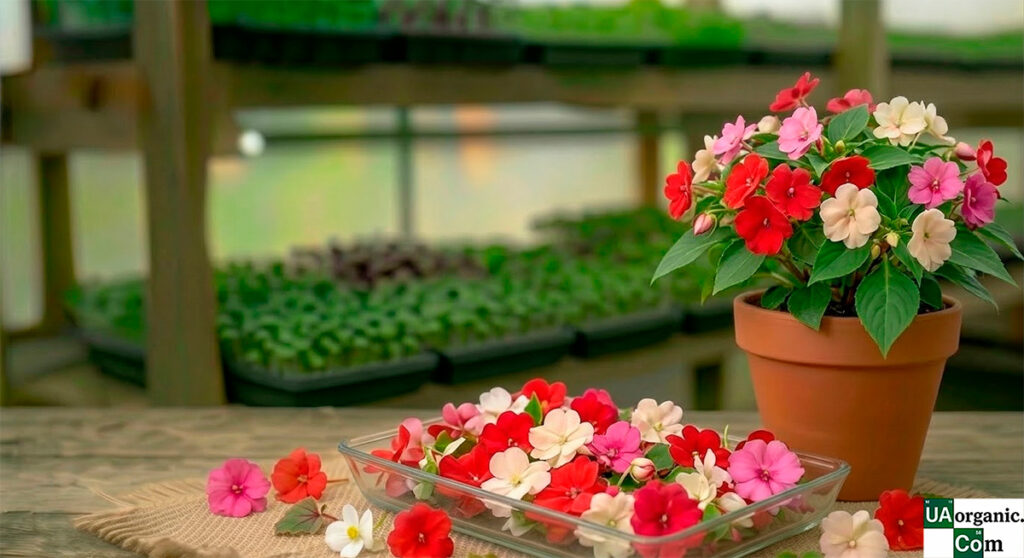
Indoor balsam (I. walleriana) is one of the few edible flowers with year-round access without any effort — it is enough to have a pot on the windowsill and not to treat the plant with pesticides. Together with wax begonia, pelargonium and Oxalis triangularis — one of the four "windowsill" edible flowers in the catalog.
| Form | Features of use |
|---|---|
| fresh | Decor of dishes and desserts, salads and cocktails; period of 1-2 days |
| Dye infusion | The flowers are brewed in water - a pink-orange infusion with anthocyanins |
| Kandovan | Decoration of cakes and pastries - the bright color lasts for weeks |
| Frozen in ice | Cocktails, lemonades are a color accent in the drink |
Taste, aroma & texture
*Impatiens walleriana* ("light", room balsam) — gentle, slightly sweet, without pronounced bitterness or acid. Some sources describe the taste as "pleasantly neutral with a floral note." *Impatiens balsamina* (garden balsam) — the taste of the flowers is almost neutral; the culinary value of flowers is primarily their color and anthocyanin content.
Gentle, floral-fresh - without bright or perfume notes. Similar to the aroma of any indoor plant after watering. It is not a key characteristic and is not transferred to the liquid during infusion.
Petals are thin, soft, delicate - similar in texture to begonia or viola petals. Flowers *I. walleriana* small (2–3 cm), *I. balsamina* are somewhat larger and appear in the axils of the leaves. Feature: when cut, the stem emits an orange-yellow juice - it is edible, but it can leave a stain on the hands and plate.
Safety & edibility
Edible flowers are not the same as florist flowers. Only flowers grown specifically for food use without synthetic pesticides are suitable.
- ✅ Flowers — raw or for infusion and dye
- ✅ Leaves and young stems — only after cooking or blanching
- ❌ Leaves and stems raw in large quantities - can accumulate calcium oxalate
- ❌ Seed pods - explode, do not use
- ❌ The roots are not used
Are all varieties edible: Genus Impatiens has more than 1000 species. Edibility is confirmed for:
- Impatiens walleriana ✅ - room "light"
- Impatiens balsamina ✅ - garden balsam
Not recommended without additional study: wild species of the genus, especially Impatiens capensis and I. noli-tangere - require heat treatment.
Heat treatment: Flowers are edible raw, do not heat for decoration. Leaves and stems - only after cooking; heat treatment destroys calcium oxalate.
- Calcium oxalate in raw leaves and stems — people prone to kidney stones or gout should use leaves and stems with caution even after cooking
- The flowers do not contain significant amounts of oxalate—they are the safest part of the plant for raw consumption
- Allergy to balsam occurs; when using for the first time, start with a small amount
- Pregnant women are recommended to use in moderation
This information is general in nature and is not medical advice. Sources: USDA FoodData Central, EFSA.
Culinary use
Balsam in cooking is primarily a color. Flowers contain anthocyanins, which are well transferred to aqueous infusion and give a pink-orange shade. A 2021 scientific study (PMC/NCBI) confirmed the potential I. balsamina as a natural colorant for the confectionery industry - in particular for the filling of marshmallow cakes in Portugal. For flowers I. walleriana gentle taste and delicate decor come to the fore.
Infusion for dye
flowers are brewed in warm water (70–80°C), infused for 15–20 minutes, strained. Pink-orange infusion for jellies, glazes and cocktails.
Candy making
petals or whole flowers are covered with egg white and sugar, dried. Bright and long-lasting confectionery decor.
Freezing in ice
the flower is placed in an ice cube tray. The color is kept in the cube.
Fresh decor
flowers are placed on the dish before serving without any preparation.
Syrup
petals are poured with hot sugar syrup (1:1 sugar and water), infused for 12–24 hours, filtered. Bright dye of pink or crimson shade for drinks and desserts.
Drying
the petals are laid out in one layer on parchment and dried at 35–40°C or under natural conditions in the shade. Keep shape and color; used in tea mixtures and as a decoration.
- Do not buy balsam from flower shops and garden centers - the plants are almost certainly treated with systemic pesticides
- Do not use leaves and stems raw in large quantities - only after heat treatment
- Do not expect a pronounced taste from flowers I. balsamina — their culinary power is in color, not in taste
Perfect pairings
panna cotta, mousse, cream - pink or orange infusion as a natural dye or flowers as decoration.
ricotta, goat cheese, cream cheese — fresh flowers on top of the cheese spread; color accent without competing with taste.
strawberries, mangoes, lychees — bright flowers as color and botanical decor.
flowers in an ice cube or infusion as a base; a pink or orange tint in a clear drink.
tarts, pies with an apple or plum - bright balsam flowers as a decoration on top; the rich color contrasts with the golden pastry.
lemon tart, orange panna cotta, grapefruit salad - the pink or purple color of the flower contrasts with the yellow citrus tones.
How to select & store
- The flowers are bright, elastic, without signs of wilting
- A plant grown without chemicals is a must, not an option
- For a room "light": a pot on the windowsill without any finishing is the simplest and most reliable option
Room "light" (I. walleriana) is in many homes — if the plant has not been treated with pesticides, the flowers can be used. For culinary use in a restaurant or commercial context — only from producers grown specifically for food use.
Freshness after cutting: 2–3 days
- Fresh flowers — airtight container with a paper towel, refrigerator +4...+6°C, term 1–2 days
- Do not wash before use
Composition & properties
A scientific study by PMC (2021) found in flowers I. balsamina 23 phenolic compounds — 9 non-anthocyanins and 14 anthocyanins. This makes flowers a valuable source of natural dyes with antioxidant and antimicrobial properties.
| Component | Meaning |
|---|---|
| Anthocyanins | 14 identified compounds in flowers are the basis of color |
| Naphthoquinones (lawson) | in leaves - used for painting nails in Asia |
| Flavonoids | are present |
| Calcium oxalate | in raw leaves and stems - destroyed during heat treatment |
| Caloric content | minimal - used in small quantities |
Impatiens balsamina is a traditional plant dye in Asia: in Japan, Korea and China, flowers have long been mixed with alum to paint nails in an orange-pink color. It is even mentioned in an Okinawan folk song Tinsagu Nu Hana as a metaphor for how parents "paint" — shape — children's minds. Balsam in Japan is also known by the name Housenka (鳳仙花).
Culinary uses of the leaves and stems are documented in Chinese Famine Foods, an ancient Chinese guide to edible plants used during famines. This emphasizes that this is not a culinary tradition for the sake of taste, but an edible plant of survival.