When and how available
| the moon | Accessibility |
|---|---|
| January — March | ❌ Not the season |
| April — May | ✅ Young leaves are the spring harvest, the most delicate |
| June — September | ✅ Peak - abundant flowering, flowers and seed pods at the same time |
| October | ✅ Completion of flowering; roots - autumn collection |
| November — December | ❌ Not the season |
Common mallow (M. sylvestris) in warm regions (southern Ukraine) blooms almost continuously from June to October. Leaves are available from early spring to late fall. Malva mala (M. neglecta) is an annual and often blooms earlier and longer. Mallow flowers open in the morning and close at night.
| Form | Features of use |
|---|---|
| Fresh flowers | Decor of dishes, salads, cocktails; natural dye for drinks; period of 1-2 days |
| Fresh leaves | Spinach substitute, soup thickener, stuffed greens; period of 2-3 days |
| Seed pods ("cheeses") | Eat raw as a snack or add to salads; seasonal product |
| Dry (flowers and leaves) | For teas, tinctures and natural dyes; stored up to 12 months |
| Dye infusion | The flowers are brewed in water — a blue-purple color that changes with pH |
| Syrup | Flowers are infused with sugar and water; violet-blue, delicate floral taste |
Taste, aroma & texture
Soft, delicately floral, slightly sweet - one of the most delicate flavors in the catalog. The flowers are practically without bitterness and without pronounced acid — purely floral tenderness. Young leaves resemble spinach: soft, slightly slimy, with a neutral vegetable taste. Seed pods ("cheeses") are juicy and tender, similar to young peas or beans in a pod, with a nutty-green taste. Older leaves become coarser and acquire a light herbal note.
Gentle, fresh floral - without bright or sharp notes. Similar to the fragrance of a field flower after rain. It is not dominant and does not interrupt the other ingredients of the dish. The leaves, when rubbed, give off a slightly herbal herbal smell.
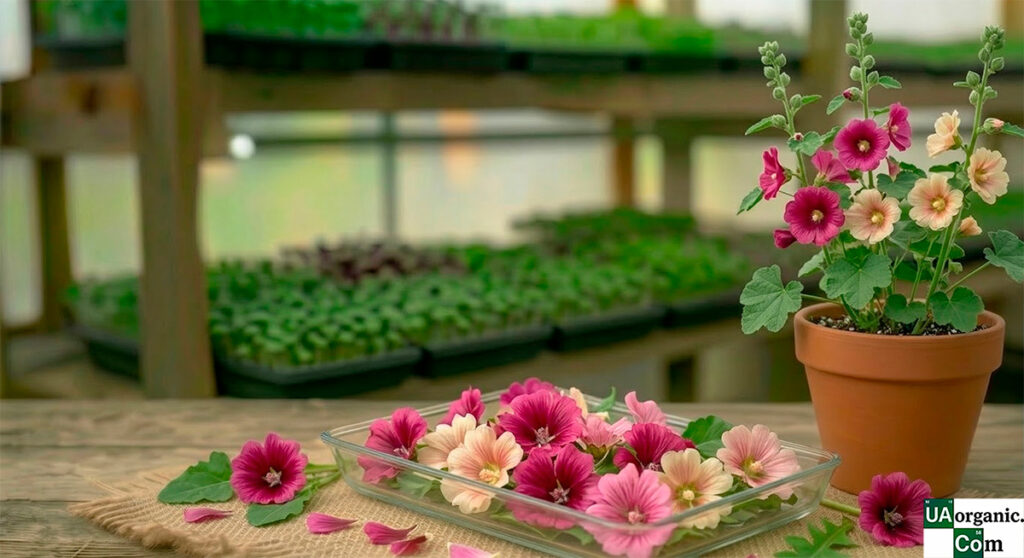
Petals are thin, delicate, slightly velvety - with characteristic dark veins that give the flower a decorative "picture". Five large petals measuring 2-4 cm each are large enough for a recognizable decoration. A key textural feature of mallow: **mucilage** is a natural mucilaginous polysaccharide found in all parts of the plant. It is he who gives the leaves and roots a slimy texture when cooking and turns mallow into a natural thickener for soups.
Safety & edibility
Edible flowers are not the same as florist flowers. Only flowers grown specifically for food use without synthetic pesticides are suitable.
- ✅ Flowers and petals - raw, for decoration and dye
- ✅ Young leaves - raw or cooked, like spinach
- ✅ Young stems are edible, but fibrous; better when young
- ✅ Seed pods ("cheese") - raw in their young form
- ✅ Roots - boiled; secretes a mucilaginous infusion during cooking
- ⚠️ Leaves grown on nitrogenous soils - may contain elevated nitrates; use sparingly
- ⚠️ Seeds in large quantities - can have a laxative effect
Are all varieties edible: Yes - almost all representatives of the Malvov family (Malvaceae), except for cotton (Gossypium hirsutum), are considered edible. Main culinary types:
- Malva sylvestris (forest mallow, tall mallow) ✅ — the most common in Ukraine
- Malva neglecta (mallow is small, squat) ✅ — garden weed, edible
- Malva verticillata (mallow mallow, Chinese) ✅ - cultivated as a leafy vegetable
- Malva moschata (musk mallow) ✅ — decorative and edible
- Alcea rosea (stock-rose, "rose") ✅ - edible, but somewhat tougher
Heat treatment: It is better not to heat the flowers for decoration - they quickly wither and darken. For the dye, it is brewed in water. The leaves tolerate cooking, stewing and blanching well - the mucilage activates when heated and thickens the liquid. The roots are boiled or infused.
- Malva belongs to the Malva family (Malvaceae) — the same as hibiscus, okra and cocoa; allergy to the family occurs, but rarely
- When grown on soils with an excess of nitrogen, the leaves may contain elevated nitrates - do not use in large quantities; collect on clean lands
- Seeds in large quantities have a laxative effect - eat "cheeses" as a snack, not as a main ingredient
This information is general in nature and is not medical advice. Sources: USDA FoodData Central, EFSA.
Culinary use
Mallow performs several culinary roles at the same time, and none of them is secondary. Flowers are a natural blue-violet dye and an elegant decoration. The leaves are a substitute for spinach and a natural thickener for soups thanks to the mucilage. Seed pods are a raw snack and a fun "garden snack." This versatility makes mallow a particularly valuable plant for chefs working with local and seasonal ingredients.
Infusion for dye
flowers are brewed in hot (not boiling) water, infused for 15–20 minutes, strained. Blue-violet infusion is used for coloring dough, drinks, jellies and glazes. When acid or alkaline medium is added, the color changes.
Cooking syrup
flowers are infused in water, strained, sugar and lemon juice are added. The syrup takes on a pink-purple color depending on the pH.
Blanching leaves
the leaves are immersed in boiling water for 1–2 minutes, transferred to cold water. Reduces slimy texture, preserves color; after blanching - for salads and side dishes.
Stewing leaves
in olive oil with garlic for 5–7 minutes; the leaves soften, the mucilage is activated and partially thickens the liquid.
Drying
flowers and leaves are dried at a low temperature or in a well-ventilated place; stored in a glass jar for up to 12 months.
Pickling buds
unopened buds are marinated in vinegar with salt and spices as capers or added to marinades.
- Do not collect mallow leaves near roads, industrial zones and from treated lawns - the plant absorbs heavy metals and nitrates; only clean soils
- Do not use leaves grown on humus-rich soils in large quantities - an increased concentration of nitrates is possible
- Do not expect a bright floral taste from the flowers - the main value of mallow as a culinary flower is color, not taste; for a taste effect, use leaves and roots
- Do not heat fresh flowers for decoration - they quickly lose color; use only fresh or in syrup and dye
Perfect pairings
Olive oil, garlic, lemon - mallow leaves are stewed in the Mediterranean and Middle Eastern tradition; flowers are a decoration when served.
Rice, couscous, broth is a Tunisian and Turkish tradition; leaves thicken the broth and give the dish a delicate texture.
fresh flowers in a salad or infusion with lemon and mint - a light summer combination.
flowers on top of goat cheese with honey - a delicate floral accent without competing with the taste of the cheese.
youth (molokhia) is an Egyptian and Levantine dish; leaves of mallow or juta (a close relative) are stewed with chicken broth and garlic; mallow is a direct substitute for jute in this recipe.
young leaves and flowers of mallow in salad; leaves are replaced by spinach or cresalat, flowers are a color accent; the Mediterranean tradition of eating mallow.
How to select & store
- Flowers are bright, pinkish-purple, with clear dark veins - without signs of wilting
- Petals are elastic and tender; the flower is fully opened
- For leaves: young, even, without yellowing and signs of decay; before the appearance of the flower stalk - the most delicate
- For "cheeses": green, dense seed pods immediately after flowering
Mallow is one of the few plants that can realistically be harvested by yourself in the wild - it grows everywhere. But only in clean places, far from roads and cultivated areas. City farms can offer mallow as microgreens or in the form of leaves. Flowers from flower shops not suitable for consumption.
Freshness after cutting: 2–3 days
- Fresh flowers — airtight container with a paper towel, refrigerator +4...+6°C, term 1–2 days
- Do not wash before use - moisture accelerates wilting
- Fresh leaves - in a damp towel in the refrigerator, for 2-3 days
- Dry flowers and leaves - sealed glass jar, dark place, up to 12 months
Composition & properties
Mallow has one of the longest continuous culinary traditions among plants in Eurasia. Even in the III century BC the Greek doctor Dyphilus Sifnosky wrote about its digestive properties. Horace described it as part of his daily diet. The key chemical component — mucilage — determines both the culinary and therapeutic uses of the plant.
| Nutrient | Value (per 100 g of fresh leaves) |
|---|---|
| Caloric content | ~20–30 kcal |
| Vitamin A (β-carotene) | ~3400–4500 μg (~380–500% of the daily norm) |
| Vitamin C | ~10–30 mg (~11–33% of the daily norm) |
| Calcium | ~200–300 mg (~20–30% of the daily norm) |
| Potassium | ~400–530 mg |
| Magnesium | ~50–80 mg (~12–19% of the daily norm) |
| iron | ~2–4 mg (~11–22% of the daily norm) |
| Mucilage | ~15–20% of dry mass — determines the thickening properties |
| Anthocyanins (flowers) | ~50–100 mg/100 g — responsible for the blue-violet color |
| Flavonoids | Quercetin, kaempferol — Barros et al., Food Chem. Toxicol. 2010 |
Malva is a relative of okra (Abelmoschus esculentus), hibiscus (Hibiscus sabdariffa), cocoa (Theobroma cacao) and... marshmallows. The first marshmallows were made from althea root (Althaea officinalis) — a close relative of mallow — and was used as a medicine for sore throat. Mucilage root was whipped into a foam with sugar and egg white. Modern marshmallows do not contain any mallow component.
Mallow is one of the oldest documented food plants of Eurasia. Archeological finds at Shanidar Cave (Iraq, ~60,000 BC) contain mallow plant pollen—although the interpretation of these finds is a matter of scholarly debate. Mallow was grown in the gardens of Charlemagne in the 9th century. not. by his decree Capitulare de villis.
Mallow leaves under the name khubeza (from the Arabic word for "bread") is a traditional spring food product in Palestine and the Levant, which acquired a special symbolic meaning during the siege of Jerusalem in 1948, when the plant became an important source of nutrition for the population.
Accurate tabular data for flowers and leaves Malva sylvestris not published as a separate line in the USDA FoodData Central database. Values are given on the basis of scientific publications. Sources: Barros L. et al. (2010) Food and Chemical Toxicology; USDA FoodData Central.