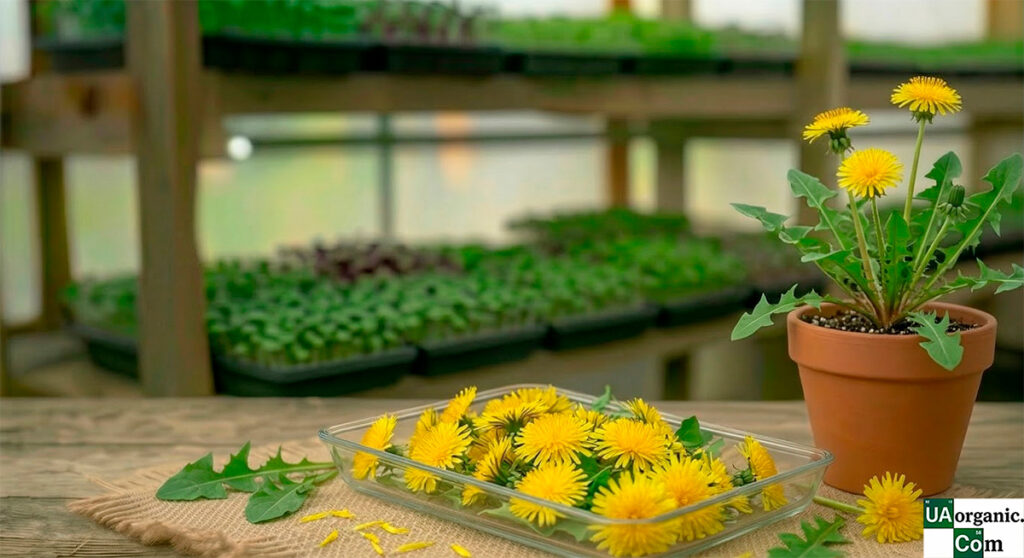
When and how available
| the moon | Accessibility |
|---|---|
| February — March | ✅ The first young leaves are the most tender and least bitter |
| April — May | ✅ Peak - abundant flowering, the best flowers and leaves at the same time |
| June — August | ✅ Repeated flowering; the leaves are bitter after the heat |
| September — October | ✅ Young autumn leaves and roots are the richest in inulin |
| November — January | ❌ Not the season |
In the spring - flowers and young leaves (the least bitter). In autumn - the root (maximum inulin and bitter compounds). Young leaves before flowering are the most tender and least bitter - they are used in salads. After flowering, the leaves become much bitter.
| Form | Features of use |
|---|---|
| Fresh flowers | Decor, salads, deep-fried food, syrup, wine; use on the day of collection |
| Fresh leaves | Salads, stir-fry, blanched greens; only young ones - before flowering |
| Pickled buds | A substitute for capers is unopened buds in a vinegar marinade |
| Syrup from flowers | Sweet, honey-floral; for drinks and confectionery |
| Wine from flowers | Traditional British and American house wine |
| Dry root (coffee substitute) | Roasted and ground root is a drink without caffeine |
Taste, aroma & texture
The petals of the flower are sweet, honey-floral, with a gentle herbal undertone. The main feature: **the green sepal under the flower is always bitter** — it is removed before use, and then the bitterness becomes minimal. Young leaves before flowering are slightly bitter, similar to radicchio or endive; after flowering - much more bitter. Unopened buds, marinated in vinegar, taste like capers - sour-salty, spicy. The roasted root gives a drink with a bitter-caramel taste, similar to chicory.
Fresh, honey-floral - one of the first aromas of spring. The flowers smell pleasant and sweet, without harsh notes. When cut, the stem emits a milky juice with a bitter smell - it is better not to suck it. Syrup from flowers smells like honey and spring — one of the most "seasonal" aromas among all preparations in the catalog.
Dandelion inflorescence consists of hundreds of small reed flowers - thin, soft, yellow petals. In the syrup, they soften completely and transfer color and taste to the liquid. When deep-fried, a whole inflorescence gives a delicate cloud. The leaves are juicy and crispy when young. The root is dense, fleshy, similar to parsnip or parsley root.
Safety & edibility
Edible flowers are not the same as florist flowers. Only flowers grown specifically for food use without synthetic pesticides are suitable.
- ✅ Petals of a flower - without a green sepal (it is bitter)
- ✅ Unopened buds - for pickling as capers
- ✅ Young leaves before flowering - for salads
- ✅ Leaves after flowering - for blanching and stewing (more bitter)
- ✅ Young stems are edible, but with milky juice; it is better to blanch
- ✅ The root is boiled, fried or dried
- ⚠️ Green sepal is bitter; remove before using the flower
- ⚠️ The milky juice of the stem is bitter; do not suck
Are all varieties edible: Yes, all species Taraxacum edible T. officinale is the most common and most researched. There are cultivated varieties with wider and less bitter leaves - 'Amélioré à Coeur Plein', 'Broad-leaved' - which are grown specifically as salad greens.
Heat treatment: It is better not to heat the petals for decoration. For syrup - brew in hot water. The leaves tolerate blanching, stewing and stir-frying well - heat treatment reduces bitterness. The root is boiled, baked and fried.
- Dandelion contains latex - people with allergies to natural rubber (latex) should be careful: possible cross-reaction
- Dandelion belongs to the Asteraceae family (Asteraceae) — people allergic to ragweed or wormwood should start with a small amount
- Dandelion has a pronounced diuretic effect (hence the popular name in France pissenlit - "wetting the bed") - people with kidney diseases or those taking diuretics should consult a doctor
- People taking blood-thinning drugs should limit consumption - dandelion contains a significant amount of vitamin K
- Pregnant women are recommended to use in moderation
This information is general in nature and is not medical advice. Sources: USDA FoodData Central, EFSA.
Culinary use
Dandelion is unique in the catalog in that its different parts perform completely different culinary functions. Flowers — for syrup, wine and decoration. The leaves are like bitter endive-like salad greens. Buds are like capers. The root is like a coffee substitute or a vegetable. This is not one edible flower, but a whole culinary plant, each part of which has its own season and technique.
Cooking syrup
flowers without sepals are poured with water, boiled for 20–30 minutes, carefully strained through a cloth, sugar and lemon juice are added. Golden syrup with honey aroma. Classics of French and Balkan cuisine.
Pickling buds
unopened dense buds are placed in a sterilized jar and poured with a marinade of apple cider vinegar, salt, sugar and spices. Keep for a week. Ready-made "capers" - for fish and sauces.
Fried flowers
whole fresh inflorescences are dipped in a light batter and fried; crispy outside and tender inside; sprinkled with powdered sugar or served with salt depending on the dish.
Blanching leaves
the leaves are immersed in boiling water for 1–2 minutes and immediately transferred to cold water; reduces bitterness and preserves bright green color; after blanching - a side dish or base for stewed dishes.
Roasting the root
the cleaned and dried root is cut and roasted in the oven at 180°C for 30–40 minutes until dark brown; ground and brewed like chicory or coffee.
Cold infusion of petals
petals are infused in cold water for 2–3 hours; the liquid acquires a golden color and a delicate honey taste; basis for jelly and cocktails.
- Do not collect dandelions from lawns in cities, along roads and from cultivated areas - the plant absorbs nitrates, heavy metals and herbicide residues; only clean meadows and field areas far from the tracks
- Do not forget to remove the green sepal before using the flower - it is bitter and spoils the taste of syrup, salad and wine
- Do not collect leaves after flowering for salad - they become too bitter; for a thermally processed side dish - suitable, for a fresh salad - not
- Do not suck the milky juice from the stem - it is bitter and can irritate the mouth of people with latex sensitivity
Perfect pairings
Bacon, vinaigrette, mustard - classic French salade de pissenlit au lard — bitter dandelion leaves, crispy bacon and warm vinegar and mustard vinaigrette; the bitterness of the leaves and the fattiness of the bacon balance each other perfectly.
Honey, lemon, syrup - syrup from dandelion flowers with honey and lemon - the basis of spring drinks and glazes; the "bee" flavor of the flower supports the honey profile.
Goat cheese, nuts, honey - young dandelion leaves in a salad with goat cheese, walnuts and honey - a classic French combination, where bitterness is compensated by fatness and sweetness.
poached or boiled eggs in a warm salad with dandelion - a French tradition; egg yolk and bitter greens are one of the basic principles of French cuisine.
unopened buds in a vinegar marinade - a substitute for capers in tartar sauces, remoulade and when served with fish and seafood.
yellow dandelion petals in syrup or infusion - the basis for dandelion "wine" and syrups; a traditional spring aperitif in France and Britain.
How to select & store
- The inflorescence is bright yellow, fully opened - collect on a sunny day in the morning (in cloudy weather, the flowers are closed)
- A fresh collection site: a clean meadow or field away from roads and buildings
- For leaves: young rosettes before the appearance of the flower stalk - the leaves are even, without yellowish-brown areas
- For buds: dense, green, completely closed
Dandelion is one of the few edible flowers that can realistically be picked by yourself in the wild. City farms can offer dandelion microgreens or young plants. If you buy, make sure that there is no chemical treatment.
Freshness after cutting: 2–3 days
- Use fresh flowers on the day of collection; flowers quickly close in the dark and cold
- Fresh leaves — hermetically sealed container, refrigerator, term 2–3 days
- Pickled buds - refrigerator, up to 3 months
- Syrup — refrigerator, up to 2–4 months
- Dry root - airtight jar, dark place, up to 12 months
Composition & properties
Dandelion is one of the most nutritious wild leafy vegetables in temperate climates—richer in micronutrients than most cultivated salad greens. In terms of vitamin K content, dandelion leaves surpass almost all garden crops.
| Nutrient | Leaves (per 100 g raw) |
|---|---|
| Vitamin K | ~778 μg (~650% of the daily norm) |
| Vitamin A (beta-carotene) | ~5854 MO |
| Vitamin C | ~35 mg |
| Vitamin E | ~3.4 mg |
| Calcium | ~187 mg |
| iron | ~3.1 mg (~2× more than in spinach) |
| Potassium | ~397 mg |
| Lutein and zeaxanthin | ~13 mg |
| Inulin (root) | ~40% of the dry mass of the root |
| Caloric content | ~45 kcal |
Dandelion has one of the longest and richest culinary and medicinal traditions among the wild plants of Eurasia. Pliny the Elder described it in "Naturalis Historia" in 77 AD. The Iroquois and Kiowa tribes in North America ate all parts of the plant even before the first Europeans arrived. In traditional Chinese medicine it is known as Pú gōng yīng for over 1000 years.
The iron content of dandelion leaves is twice that of spinach. In terms of vitamin K content, it is one of the richest plant sources among leafy greens. The root contains up to 40% inulin by dry weight — one of the highest indicators among plants; inulin is a prebiotic that nourishes the beneficial intestinal microflora.
In France, dandelion (pissenlit) is part of the official market assortment of spring greens — it is sold alongside radicchio and endive. In Belgium and Luxembourg "mel de Pisanly" (dandelion syrup) is a traditional product with a hundred years of continuous tradition.
Data: USDA FoodData Central for leaves Taraxacum officinale.