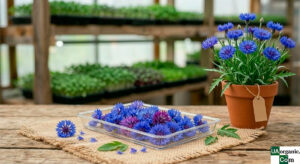
When and how available
| the moon | Accessibility |
|---|---|
| February — April | ✅ Young leaves and shoots - spring collection |
| May — June | ✅ The beginning of flowering - C. persicifolia, C. rotundifolia |
| July — August | ✅ Peak - abundant flowering, flowers and leaves at the same time |
| September — October | ✅ Autumn leaves and roots; completion of flowering |
| November — January | ❌ Not the season |
Young leaves before flowering are the most delicate and soft to the taste; spring peak quality. Flowers — throughout the summer, depending on the species. Rampion roots (C. rapunculus) is best in the fall of the first year or in the spring of the second.
| Form | Features of use |
|---|---|
| Fresh flowers and buds | Decoration of dishes and salads; period of 1-2 days |
| Fresh leaves and shoots | A substitute for spinach or greens in a salad; period of 2-3 days |
| Roots (C. rapunculus) | Cooked or raw like radish; a separate garden product |
| Candied flower | The decor of cakes and pastries is blue and purple |
| Frozen in ice | Cocktails and lemonades — a blue-purple accent |
Taste, aroma & texture
Delicate, slightly sweet, soft - bellflowers have one of the most delicate flavors among wild edible flowers. Without pronounced bitterness and without acid. Some foragers describe the young leaves as "spinach without character"—that is, a neutral green that blends well with other ingredients without overpowering them. Rapunculus roots (*C. rapunculus*) are nutty-sweet, similar to parsnips or radishes; the most pronounced taste among all parts of the plant. Flowers and buds have a slightly sweet, herbal-floral taste.
Gentle, fresh floral - without bright aromatic notes. It is not transferred to the liquid during infusion. The main value of flowers is color and shape, not aroma.
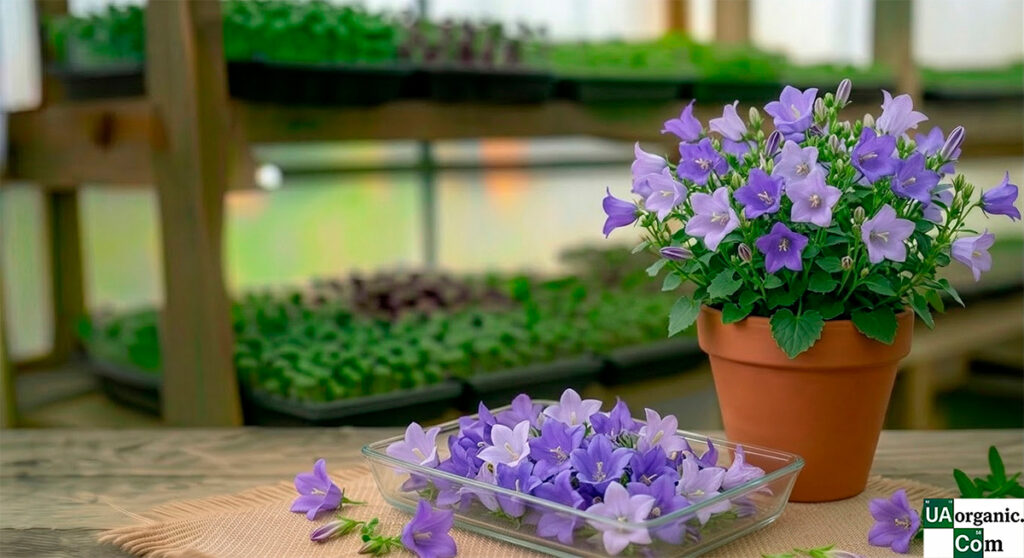
Bell-shaped flowers, 2–4 cm, five fused petals form a characteristic bell shape — recognizable and elegant. The petals are delicate and thin, slightly waxy. The shape of the bell is preserved well when candied — one of the most interesting textures for confectionery decor due to its three-dimensional shape. Leaves of medium density, slightly hairy in some species.
Safety & edibility
Edible flowers are not the same as florist flowers. Only flowers grown specifically for food use without synthetic pesticides are suitable.
- ✅ Flowers and buds — raw or for decoration
- ✅ Young leaves and shoots - raw or cooked, like spinach
- ✅ Roots C. rapunculus and C. rapunculoides — raw or cooked
- ⚠️ The leaves of some species have a slightly hairy surface - it is better to blanch before use
Are all varieties edible: Yes - almost all 300-425 species of the genus Campanula are considered edible. There is no documented toxic species within the genus.
Heat treatment: It is better not to heat the flowers - they lose their shape. The leaves tolerate blanching and stewing well. The roots are boiled or eaten raw.
- Bluebells are a rare example of a wild edible plant without significant caveats — allergies are rare, no toxic compounds have been detected
- Collect only in clean areas away from roads, industrial areas and cultivated lawns
- Do not confuse with lilies (bells of the forest Hyacinthoides and the like) - they are NOT Campanula and are not edible
This information is general in nature and is not medical advice. Sources: USDA FoodData Central, EFSA.
Culinary use
Bluebells are both a leafy vegetable and a decorative edible flower — depending on the part of the plant and the season. In the spring, young leaves and shoots are like greens. Flowers for decoration in summer. In cultivated rampion (C. rapunculus) is also a root like a vegetable. The flowers perform primarily a decorative function: their elegant bell-shaped shape and blue-violet color are the main culinary asset.
Fresh decor
flowers are placed on the dish immediately before serving. Nothing is needed - pure flower from a proven source.
Candy making
the bell-shaped shape candies perfectly and retains its volume; cover with egg white and sugar, dry. A special effect compared to flat flowers.
Freezing in ice
the flower is placed in an ice cube tray; blue-violet color looks advantageous in a transparent cube.
Blanching leaves
young leaves are immersed in boiling water for 1–2 minutes; reduces hairiness and slightly softens; side dish or base for stews.
Boiling the root
the root of the rampion is cleaned and boiled or baked, like parsnip or turnip; can be eaten raw in salads.
Stuffing a flower
the cup-shaped shape of the bell is ideal for filling: cream cheese, ricotta mousse or herbal paste fill the flower. Served as an appetizer or amuse-bouche.
- Do not buy flowers from garden centers and flower shops - even decorative ones Campanula treated with pesticides
- Do not confuse the bells (Campanula) with forest bells-hyacinths (Hyacinthoides non-scripta) — they are toxic and not at all similar botanically, but popular confusion happens
- Do not collect along roads and railways - the bell creeps (C. rapunculoides) is a common weed but absorbs heavy metals near highways
Perfect pairings
goat cheese, ricotta, burrata — blue-purple flowers on top of white cheese provide a color contrast without flavor competition.
poached eggs, egg toast - bell flowers on a yellow background of yolk and white bread; effortless botanic presentation.
young bell leaves mixed with other greens; neutral taste gives a good combination with more spicy ingredients.
strawberries, blueberries, raspberries - a blue-purple flower in a fruit salad; color play on contrast.
flowers as a decoration for salmon, trout or tartar - an elegant blue-violet note in a Scandinavian or Nordic presentation.
chicken breast, veal, turkey - a bell as a floral decoration in elegant servings; blue-violet color looks elegant on neutral flesh tones.
How to select & store
- Flowers bright blue or purple, fully open or beginning to open; without wilting
- For leaves: young basal rosettes before the appearance of the flower stem
- For rampion root: the first year of cultivation (spring-autumn) is the most delicate
Bluebells are one of the few edible flowers that can realistically be collected in the wild - they are widely distributed in meadows, forest edges and slopes throughout Ukraine. But only in clean places. City farms can grow bluebells as microgreens or young plants. C. rapunculus is cultivated as a garden vegetable - seeds are available in specialized stores.
Freshness after cutting: 2–3 days
- Fresh flowers — airtight container with a paper towel, refrigerator +4...+6°C, term 1–2 days
- Fresh leaves - in a damp towel in the refrigerator, for 2-3 days
- Roots - in the refrigerator, wrapped in a paper towel, for up to a week
Composition & properties
Genus Campanula is one of the largest in the temperate flora — 300–425 species. A detailed nutrient analysis was not conducted for most edible species. C. rapunculoides confirmed as a significant source of vitamin C in the leaves.
| Nutrient | Value (per 100 g) |
|---|---|
| Caloric content | ~25–35 kcal |
| Vitamin C | significant amount in leaves (Go Botany: "high in vitamin C"); in flowers - less |
| Vitamin A (beta-carotene) | traces |
| Anthocyanins | present in flowers — are responsible for the blue-violet color |
| Flavonoids (quercetin, luteolin) | are present |
| Inulin | present in roots (C. rapunculoides) is a prebiotic |
| Tanning substances | are present |
| Potassium, Calcium | traces |
Name Campanula rapunculus literally means "little bell turnip" - and it is this plant that is "Rapunzel" in the 1812 fairy tale by the Brothers Grimm. A pregnant woman wanted a radish salad from a wizard neighbor's garden so much that the father agreed to give the baby away in exchange for the plants. The tale reflects the real value of rampion as a vegetable: in the 16th–17th centuries. it was widely cultivated throughout Central and Southern Europe.
Campanula rotundifolia ("harebells") is the national flower of Scotland and one of the most common symbols of Scottish meadows and hills. In folk tradition, it was considered a flower of fairies.
Bluebells are one of the rare culinary plants, where almost all species are edible - the family Campanulaceae does not contain any documented toxic representative among about 400 species Campanula.
Accurate tabular data for flowers Campanula not published in the USDA FoodData Central database. Sources: Plants For A Future, Go Botany.