When and how available
| the moon | Accessibility |
|---|---|
| January — April | ❌ Off season (open soil) |
| May | ✅ Beginning of flowering |
| June — July | ✅ Peak — mass flowering, best quality |
| August | ✅ Repeated flowering after pruning |
| September — December | ❌ Open soil is completed |
Schnitt-onion can be grown at home year-round in a pot on a windowsill with sufficient lighting. City farms can supply flowers for a long season. After the first flowering, cut the inflorescences - the plant will bloom again.
| Form | Features of use |
|---|---|
| fresh | The main form is whole heads or individual flowers, the term is 2–3 days |
| dry | For decoration and seasoning, the color fades, the onion aroma is preserved |
| In vinegar | Vinegar acquires a bright pink-purple color - a spectacular preparation |
| In oil | Vegetable oil with flowers for dressings and finishing |
Taste, aroma & texture
Soft onion-garlic, spicy, without the sharpness of ordinary onions. There is a light sweetish note, which makes the flower more accessible and delicate than raw schnitt in pyknos. Individual flowers have a more concentrated taste than the leaves of the plant. In general, the flower is a more intense version of green onion with a floral nuance.
A light allium aroma is pleasant, spicy, without aggressive sharpness. When the flowers are crushed, a more pronounced garlic-onion smell is released. Does not interrupt other ingredients, but is noticeably present. In vinegar, the aroma becomes softer and more rounded.
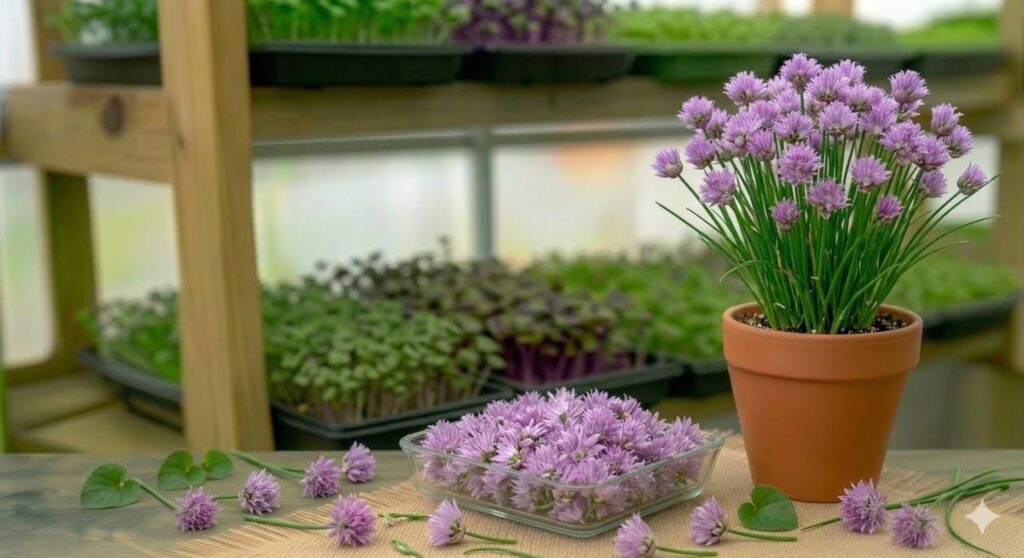
Each spherical inflorescence consists of 20–30 small tubular flowers. Individual flowers are dense, slightly crispy - much stronger than the delicate petals of a rose or nasturtium. They keep their shape well when served. The whole inflorescence is elastic, spherical, expressive as an element of decor.
Safety & edibility
Edible flowers are not the same as florist flowers. Only flowers grown specifically for food use without synthetic pesticides are suitable.
- ✅ Whole inflorescence (flower head)
- ✅ Individual flowers
- ✅ Stems and leaves (standard green onion)
- ✅ Buds
Use inflorescences or individual flowers fresh as a side dish or in dishes. The stems and leaves are also edible, like the usual chives.
For whom caution:
- People with sensitivity or intolerance to onion (Allium) — use with caution; may cause stomach discomfort
- Dogs and cats — Allium plants are toxic to pets; do not leave in accessible places
- Pregnant - safe in normal cooking amounts
Confusion with other plants: Allium schoenoprasum is easily identified by the characteristic onion smell when rubbing the leaf. If the leaf does not smell like onions, it is another plant (for example, Colchicum autumnale is poisonous). Always smell before use.
This information is general in nature and is not medical advice. Sources: USDA FoodData Central, EFSA.
Culinary use
Chive-onion flower is unique in that it is both a herb and a decoration. It fills the niche between flower and grass: it decorates like a flower, but tastes like a favorite spice. It is easiest to describe it through the contrast — where there is fish, eggs or cream cheese, the butcher's flower will be in place. The effect of pink vinegar is one of the most famous culinary "magics" among edible flowers.
Sorting into flowers
the inflorescence can be left whole (decor) or disassembled into separate tubular flowers (for even distribution in the dish). They are separated by light pulling or tapping on the inflorescence.
Vinegar infusion (rose vinegar)
fresh flowers are freely placed in a clean glass jar or bottle, filled with apple or white wine vinegar at room temperature (not hot). After 1-2 weeks, the vinegar turns bright pink. The more flowers, the more intense the color. After infusion, the flowers are removed, the vinegar is stored for months.
Flower oil
softened butter is mixed with individual flowers and a finely chopped stalk of sausage. Wrap in cling film in the form of a roll and cool. Cut into circles for serving.
Fresh decor at the finish
inflorescences or individual flowers are added to cold dishes immediately before serving. Avoid heating - the color fades, the texture softens.
Drying
inflorescences are dried in the shade with good ventilation; dry flowers retain onion aroma and color for up to 6 months; used in mixtures of spices and herbs.
Candy making
the inflorescences are covered with egg white and sugar; spectacular decor for desserts with an unexpected piquant onion taste; an unusual combination of sweet and spicy.
- Do not add to hot dishes at the cooking stage - the purple color turns gray-brown when heated; only finishing or cold dishes
- Do not store for more than 2-3 days, even in the refrigerator - the inflorescences open further, the flowers fall off; order or cut to a specific serving
- Do not use if the plant does not smell of onions - all onions are easily recognized by their smell; no smell means it is not an Allium and potentially dangerous
- Do not give to animals - Allium plants are toxic to cats and dogs even in small amounts
Perfect pairings
poached eggs, scramble, omelet, egg salad — a classic combination, where the onion note of the flower replaces or complements the green onion, but looks many times more elegant.
cream cheese, ricotta, goat cheese, feta - a spicy flower and a creamy base complement each other; classic spread on bread or crackers.
salmon (roasted, lightly salted, tartare), trout, scallops - the allium note is a natural partner for fish, and the floral form elevates the presentation to restaurant level.
creamy potato soup, viquisoise, baked potatoes with sour cream - a few flowers on top replace green onions and decorate the dish at the same time.
the onion note of chive flowers organically fits into creamy sauces for pasta or risotto; individual flowers as a finishing decoration instead of dry herbs.
guacamole, avocado toast, avocado sandwich - spicy onion flower enhances the creamy taste of avocado and gives color on a green background.
How to select & store
- The spherical heads are completely or almost completely open - they do not fall off
- The color is saturated purple-pink-lilac, without browning
- The stem is elastic, not soft and not slippery
- Smell - when you squeeze the stem, you can feel a soft onion aroma
Where to buy is important: Buy only from proven producers, grown specifically for the food industry. Use chives from your own garden only if there is no chemical treatment. Decorative onions (Allium giganteum, etc.) — not for consumption.
Freshness after cutting: 2–3 days
- Fresh inflorescences — in a glass of water as a bouquet or in an airtight container, refrigerator +4...+6°C, term 2–3 days
- For rose vinegar - process freshly picked flowers immediately (maximum pigment release)
- Do not wash before use - moisture accelerates shedding of flowers
Composition & properties
Chive flowers have a better nutrient profile than most ornamental edible flowers, thanks to the quercetin, vitamin C and sulfur compounds found in all alliums.
| Nutrient | Value (per 100 g of fresh flowers) |
|---|---|
| Caloric content | ~30 kcal |
| Vitamin C | ~58 mg (~65% of the daily norm) |
| Vitamin K | ~150–210 μg |
| Quercetin | ~50–150 mg — higher than in leaves |
| Allicin and sulfur-containing compounds | ~0.5–1% of raw mass |
| Calcium | ~92 mg |
| iron | ~1.6 mg |
Chive flowers contain higher concentrations of quercetin than the leaves of the same plant—one of the few documented cases where the flower is nutritionally more interesting than the leafy greens. Quercetin is the subject of active scientific research as a plant flavonoid with antioxidant properties.
The pigment that makes vinegar pink is anthocyanins. These are the same substances contained in blueberries, red cabbage and beets. The reaction with the acid of the vinegar makes the color brighter (pH indicator effect): the more acidic the vinegar, the brighter the pink. It is a natural chemistry without any dyes.
The information is general in nature and does not constitute medical advice. Data: USDA FoodData Central, EFSA.