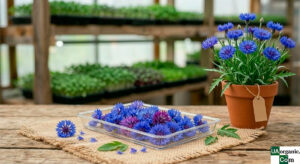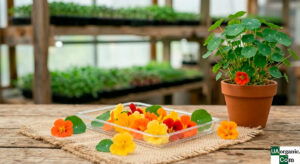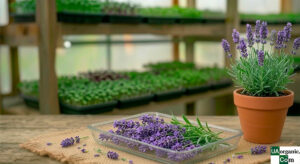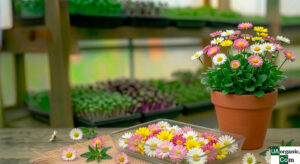
When and how available
| the moon | Accessibility |
|---|---|
| January — March | ⚠️ Leaves are available (evergreen plant in mild conditions); there are no flowers |
| April — May | ✅ Beginning of flowering; the first flowers, young leaves are the most delicate |
| June — July | ✅ The peak of flowering - the best flowers; leaves at the peak of aroma |
| August — September | ✅ Continues to bloom; after cutting, re-blooming is possible |
| October — December | ⚠️ Sheets are available; flowering ends |
Salvia is a semi-evergreen semi-shrub: leaves are available almost all year round even in the open soil of a mild climate. Flowers are a seasonal bonus. City farms supply both leaves and flowers year round.
| Form | Features of use |
|---|---|
| fresh (flowers) | Decor and aromatic accent in cold dishes; period of 3–5 days |
| fresh (leaves) | The main culinary form is a maximum of essential oils and aroma |
| dry (leaves) | Classic seasoning; the aroma is concentrated during drying |
| Fried (leaves — salvia fritta) | Italian classics - leaves in batter or pure butter; crispy snack |
| Oil with sage | Spicy butter for pasta, gnocchi and meat; leaves and flowers are both suitable |
| Candied (flowers) | For the confectioner — flowers in sugar; purple accent on desserts |
Taste, aroma & texture
Pronounced, spicy, with a camphor and slightly mustard character - immediately recognizable. Sage leaves have one of the strongest flavor profiles among culinary herbs. The flowers are much softer: the same spicy base, but without the sharpness of the leaf, with an additional floral and slightly sweet tone. In the British culinary tradition, the taste of sage is described as spicy with a slight peppery tone. In the dish, the flower gives a spicy note without the risk of "over-peppering" the dish - it is easier to do this with a leaf.
Intense, camphor-herbal - a characteristic "sage smell" that cannot be confused. Flowers smell the same, but many times more restrained. The aroma is distinctly felt upon direct contact and weakly — in the finished cold dish. In hot dishes, essential oils are revealed completely.
The leaves are hardened, velvety, covered with fine hairs - they are usually cooked or chopped. The flowers are double-lipped, a little denser than the petals of most edible flowers - there is a light chew. Velvety and pleasant to the touch. The size of the flower is medium - you can read it in the dish even without looking for it.
Safety & edibility
Edible flowers are not the same as florist flowers. Only flowers grown specifically for food use without synthetic pesticides are suitable.
- ✅ Flowers and petals are edible, delicate aromatic decor
- ✅ Fresh leaves are the main culinary part
- ✅ Dry leaves are a classic seasoning
- ✅ Young shoots are edible, more tender than adult leaves
- ❌ Old woody stems and roots are not used
Are all varieties edible: Culinary sage - exclusively Salvia officinalis and its cultivars (Purple Sage, Tricolor, Berggarten, Purpurascens and others). Not edible or not culinary:
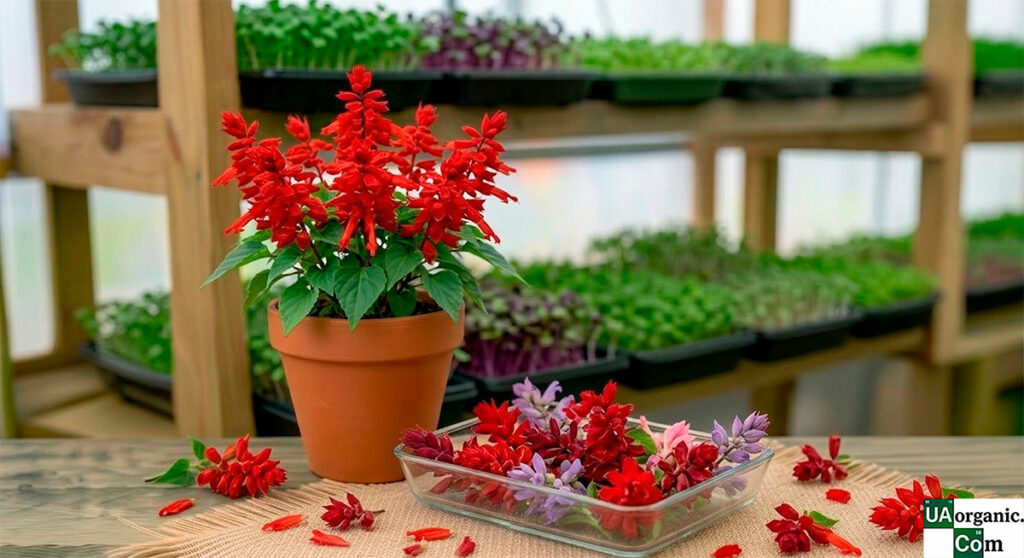
- Salvia splendens (scarlet salvia) is a decorative annual plant with bright red flowers; not consumed
- Salvia leucantha (Mexican salvia) is an ornamental bush; not culinary
- Salvia nemorosa (forest sage) — decorative perennial; not culinary
- Salvia divinorum — a psychoactive plant; absolutely not for food use
- Salvia elegans (pineapple salvia) — the flowers are edible and taste like pineapple/honeydew; a separate culinary plant
Heat treatment: The flowers are better served raw or added at the last moment - they are more delicate than the leaves. The leaves perfectly tolerate frying, baking and extinguishing - when heated, the essential oils are completely revealed.
- Salvia contains thujone, a natural compound of the essential oil. In culinary quantities (a few leaves or flowers), thujone is absolutely safe. A toxic effect is possible only when using concentrated essential oil or very large quantities of the plant - which is practically impossible in cooking
- Pregnant women are advised to use in moderation and avoid large amounts — a traditional caution with strong aromatic herbs
- People taking anticonvulsant drugs and sedatives should consult a doctor when regularly used in large quantities (relevant for herbal teas, not for culinary use of flowers)
This information is general in nature and is not medical advice. Sources: USDA FoodData Central, EFSA.
Culinary use
Salvia is a rare case of an edible flower, where the greater culinary contribution is made by the leaf, and the flower is a more delicate, more refined version of the same taste. Chefs who have long worked with sage leaves in classic Mediterranean and Central European cuisine are discovering the flower as a way to bring a "salvia" character to a dish without harshness — and at the same time get a spectacular purple-blue decoration. It is a powerful aromatic herb with a thousand-year culinary tradition, where the flower takes its rightful, albeit humbler, place.
Fried leaves (salvia fritta)
the leaves are fried in light batter or pure oil on medium heat until crispy. Classic Italian technique, where salvia turns into an independent snack.
Aromatic oil
leaves and flowers are fried in butter for 1–2 minutes until the aroma appears; the oil becomes spicy and acquires a delicate green shade. Serve immediately or store in the refrigerator for up to a week.
Insisting in oil
leaves and flowers are poured with olive oil for 1–2 weeks. The oil acquires a spicy aroma and is used for dressings, marinades and finishing.
Candied flowers
the flowers are covered with egg white and fine sugar, dried. Violet-blue color is well preserved; used to decorate desserts.
Drying
classic workpiece; leaves are hung or dried in the shade. When drying, the aroma concentrates and changes tone — more camphor sharpness appears.
Fresh decor with flowers
sage flowers (blue-purple) as a delicate decoration in the dish; a much milder scent compared to the leaves - perfect where a visual note is needed without the sage dominating.
- Do not buy salvia in flower shops or garden centers without a confirmed species - decorative "salvias" (S. splendens, S. nemorosa) are not culinary and may be treated with preservatives
- Do not confuse culinary S. officinalis with decorative species — especially bright red S. splendens, which is widely sold as "salvia" in garden stores
- Do not use salvia essential oil — the concentrated oil contains dangerous amounts of thujone; culinary use of the leaves and flowers is safe, the oil is not
- Do not overload the dish with leaves - salvia is a strong herb; 2–4 leaves per serving are enough; flowers are softer, they can be served more
Perfect pairings
pork, duck, lamb, sausages — a classic Mediterranean combination; the spiciness of sage cuts through the greasiness and refreshes the palate. In Italy, sage is an indispensable seasoning for dishes such as saltimbocca and is traditionally combined with fish.
gnocchi burro e salvia is one of the simplest and most famous dishes of Italian cuisine; sage leaves or flowers are fried in butter until crispy and served with pasta or gnocchi.
pumpkin puree soup, baked sweet potato, parsnips — spicy sage emphasizes the sweet earthiness of root vegetables; one of the most popular autumn combinations.
ricotta, mascarpone, cream cheese - salvia flowers as an aromatic accent on the cream base; taste without harshness.
leaves and flowers in egg dishes - a spicy note without interrupting the main taste; classic herb omelets.
beans, chickpeas, lentils - sage is traditionally combined with legumes in Tuscan and Umbrian cuisine; roasted leaves or flowers as a fragrant finishing accent.
How to select & store
- The flowers are blue-lavender or pink-lavender, elastic, fully opened
- The leaves are grayish-green, velvety, without yellowing or spots
- The aroma is pronounced and characteristic — camphor-spicy; without extraneous odors
- Stems are not woody - young shoots with flowers are optimal
Where to buy is important: Buy edible salvia only from proven growers Salvia officinalis especially for the food industry. Plants from garden centers can be decorative varieties or treated with protective agents.
Freshness after cutting: 2–3 days
- Fresh flowers on a shoot — in a glass of water as a bouquet or in an airtight container, refrigerator, 5–7 days
- Leaves — airtight container or bag with a paper towel, refrigerator +4...+6°C, term up to 2 weeks
- Do not wash before use - moisture accelerates wilting
- Dry leaves - hermetically sealed container in a dark place, up to 1 year
Composition & properties
Sage is one of the best researched culinary herbs. USDA FoodData Central has complete data for fresh leaves S. officinalis; the phytochemical composition has been studied in depth.
| Nutrient | Value (fresh leaves, 100 g) |
|---|---|
| Caloric content | ~315 kcal (fresh ~25 kcal, used in small quantities) |
| Vitamin K | ~1714 μg (~1428% of the daily norm) is one of the highest indicators among herbs |
| Vitamin C | ~32.4 mg (~54% of the daily norm) |
| Vitamin A | ~5900 MO |
| Calcium | ~1652 mg |
| iron | ~28 mg |
| Manganese | ~3.1 mg |
| Potassium | ~1070 mg |
| Magnesium | ~428 mg |
| Thujone (α- and β-thujone) | Present in essential oil — safe in culinary amounts |
| Rosmarinic acid | present |
| Flavonoids (apigenin, luteolin) | are present |
| Tanning substances | are present |
Sage is one of the oldest and most thoroughly studied culinary herbs. It has been cultivated and used in the Mediterranean for at least 2,000 years. The very name of the genus Salvia comes from Latin salvere — "to be healthy" — which reflects the thousand-year tradition of using the plant.
Among the nutrients, an exceptional concentration of vitamin K stands out - one of the highest indicators among culinary herbs. The leaves are also a source of vitamin C and calcium, although when used in cooking (small amounts) the contribution to the daily norm is moderate.
The essential oil of the leaves contains thujone, a compound that is the subject of research. In culinary quantities (several leaves or flowers per dish), it is absolutely safe. Rosmarinic acid and flavonoids are the subject of scientific research in the context of antioxidant properties.
Composition data: USDA FoodData Central — Sage, fresh. Data are given for leaves; data for flowers are not available separately. The information is general in nature and does not constitute medical advice.