When and how available
| the moon | Accessibility |
|---|---|
| January — April | ❌ Off season (open soil) |
| May | ✅ The beginning of flowering, the first inflorescences |
| June — August | ✅ Peak - abundant flowering, best quality |
| September | ✅ The end of the season, the quality gradually decreases |
| October — December | ❌ Not the season |
Controlled-environment urban farms can theoretically supply clover year-round, but in practice it is rarely grown in closed systems—mostly harvested seasonally from certified plots.
| Form | Features of use |
|---|---|
| fresh | The main form — maximum aroma and tenderness, duration 1–2 days |
| dry | For herbal teas, aromatic mixtures, decoration of dry confectionery products |
| Kandovan | Desserts, cakes, pastries - keeps its shape for weeks |
| Syrup | Clover syrup for cocktails, lemonades, ice cream |
| Infusion | In honey or cream to give a floral aroma |
Taste, aroma & texture
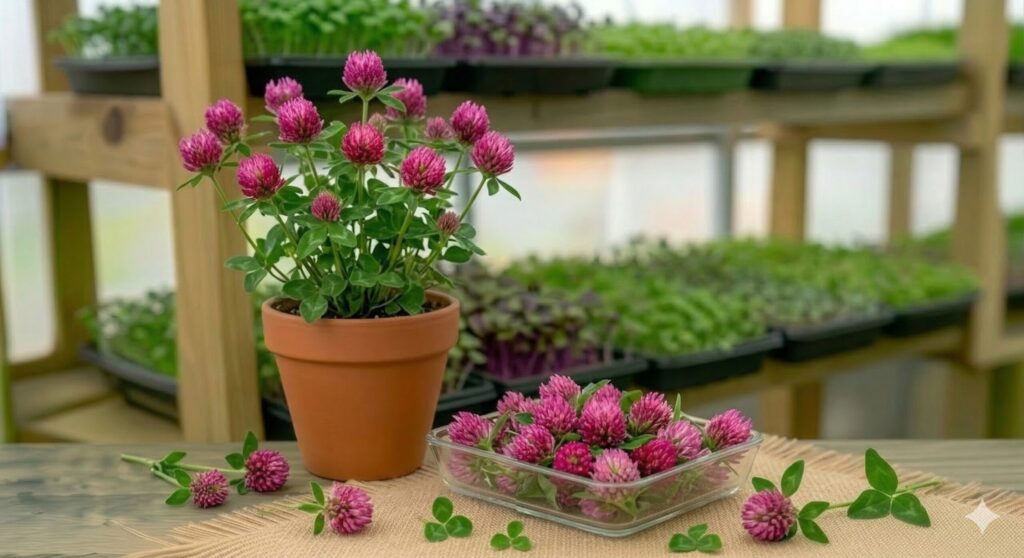
Soft, honey-sweet with a subtle floral note and barely perceptible grassiness. White clover (*Trifolium repens*) is sweeter and more delicate, almost without bitterness. Red (*Trifolium pratense*) is more intense — the floral taste is more expressive, with a slight tartness. Individual flowers of the inflorescence melt on the tongue, leaving a honey-floral shade.
Light, honey-floral. Not intense at a distance, but noticeable in direct contact. The aroma of red clover is somewhat deeper and richer than that of white clover. It is this aroma that makes clover honey one of the most valuable types of honey.
The inflorescence consists of many small tubular flowers. Individual flowers are extremely delicate, soft, practically dissolve in the mouth. A whole inflorescence gives a feeling of volume and lightness at the same time. The stems of the inflorescence are tougher - they are usually not used or removed.
Safety & edibility
Edible flowers are not the same as florist flowers. Only flowers grown specifically for food use without synthetic pesticides are suitable.
- ✅ Flowers — a whole inflorescence or individual flowers
- ✅ Young leaves - in moderate quantity, have a grassy taste
- ❌ Stems in large quantities are hard, not recommended
- ❌ An old or yellowed flower is not suitable for consumption
Are all varieties edible: Edible Trifolium repens (white) and Trifolium pratense (red). Not to be confused with with a grunt (Melilotus officinalis, Melilotus albus) — it contains coumarin and is not edible in the culinary sense. The difference: burkun has long spike-like inflorescences (not spherical), and a characteristic smell of fresh hay when rubbed.
Heat treatment: Not recommended for fresh flowers - the petals quickly lose their color and texture. For syrups and infusions, short-term heating is permissible.
- To people who accept anticoagulants (blood thinners), you should be careful with the use of large amounts of red clover - it contains compounds with weak coumarin-like activity
- Pregnant it is recommended to use in moderation, without overindulgence in large quantities
- When using for the first time, start with a small amount - individual sensitivity is rare, but possible
This information is general in nature and is not medical advice. Sources: USDA FoodData Central, EFSA.
Culinary use
Clover is an accent flower with a minimal effect on the taste balance of the dish. Its honey-floral taste is delicate enough to complement, not dominate. It is primarily used as a delicate flower decoration, an ingredient of herbal teas and syrups, and also as an element of confectionery decoration after canding. In its fresh form, it behaves well in desserts and salads, where a light sweet accent is needed.
Candy making
cover the flowers with beaten egg white and fine sugar, dry at room temperature or in an oven at 40°C. Keeps its shape for months, ideal for decorating cakes and pastries.
Infusion in syrup
fresh or dried flowers are poured with hot simple syrup (1:1 water and sugar), infused until cooled and filtered. Flower syrup is used in cocktails, lemonades and desserts.
Insisting in cream or milk
the inflorescences are infused in cold cream for 4–8 hours. Strained cream acquires a delicate honey-floral aroma and is suitable for panna cotta, ice cream, creme brulee.
Drying for tea
inflorescences are dried at a low temperature (30–40°C) or naturally in the shade. Dried clover preserves its aroma and is used in herbal teas.
Fresh decor
clover inflorescences are placed whole on the dish before serving; the pink or white spherical flower holds its shape well for 3-4 hours after cutting.
Infusion in vinegar
fresh clover flowers are poured with apple or white vinegar; insist 2–4 weeks; vinegar acquires a pink hue and a delicate honey-floral aroma.
- Do not add to hot dishes - when heated, the flowers instantly turn brown and lose their shape; clover only for cold dishes or final decoration
- Do not store fresh flowers for more than 1-2 days, even in the refrigerator - they are extremely delicate and quickly wither; order for a specific serving
- Do not confuse clover (Trifolium) with a grumble (Melilotus) — outwardly similar, but burkun is not suitable for culinary use
- Do not wash under a strong jet - carefully immerse in cold water, shake slightly and dry on a paper towel
Perfect pairings
ricotta, mascarpone, cream cheese, yogurt — the honey-floral note of clover perfectly emphasizes the creamy base without excessive intensity. A classic combination of French and Scandinavian cuisine.
honey cake, baklava, honey mousse - clover enhances the honey theme without excess sugar, gives a floral aroma and sophisticated decor.
strawberries, raspberries, blueberries, peaches — a light herbal note of clover contrasts with berry acidity and emphasizes the natural sweetness of the fruit.
lemonade, lemon tart, orange cream — the acidity of citrus favorably shades the honeyed sweetness of clover, giving a fresh and complex aroma.
clover lemonade, flower cocktails, iced tea - the easiest and most effective way of use. Flowers in a glass or frozen in ice immediately raise the level of serving.
fresh or dried clover flowers as a topping for oatmeal, muesli or granola; the honey-floral aroma is suitable for cereal breakfasts.
How to select & store
- The inflorescence is elastic, spherical, without darkened or faded flowers
- The color is uniform - white or pink-purple, depending on the species
- The aroma is light honey-floral; the absence of smell indicates an old flower
- No traces of insects or mechanical damage
Where to buy is important: Buy edible clover flowers only from proven producers, grown specifically for the food industry, or collect from your own plot, where no chemicals are guaranteed to be used. Flowers from flower beds, parks and roadsides not suitable for consumption.
Freshness after cutting: 2–3 days
- Fresh flowers — airtight container with a paper towel, refrigerator +4...+6°C, term 1–2 days
- Do not wash before direct use - moisture accelerates wilting
- Dried flowers - paper bag or glass jar, dark dry place, up to 12 months
Composition & properties
Clover is traditionally used in folk medicine, and modern research confirms the presence of valuable plant compounds in it. Red clover is one of the richest plant sources of isoflavones.
| Nutrient | Value (per 100 g of fresh flowers) |
|---|---|
| Caloric content | ~20–25 kcal |
| Vitamin C | ~15–20 mg |
| Vitamin A (beta-carotene) | present |
| Calcium | ~80–100 mg is above average for flowers |
| iron | ~1–2 mg |
| Flavonoids (quercetin, kaempferol) | are present |
| Isoflavones (formanetin, biochanin A) | present — especially in red clover |
| Polyphenols and antioxidants | are present |
Clover is one of the plant sources of isoflavones — phytoestrogens, which are the subject of active scientific research. Their highest content is in red clover (Trifolium pratense). The flavonoids quercetin and kaempferol found in clover are being studied in the context of antioxidant properties. Clover honey is traditionally considered to be one of the most beneficial because bees transfer floral compounds into honey.
The information is general in nature and does not constitute medical advice. Composition data: USDA FoodData Central.