
When and how available
| the moon | Accessibility |
|---|---|
| January — May | ❌ Not the season |
| June | ✅ Beginning of flowering with early sowing |
| July — October | ✅ Peak - abundant continuous flowering until the first frosts |
| November — December | ❌ Not the season |
Cosmeia blooms continuously from the first bloom to the first frost - one of the longest-season edible flowers. New flowers appear daily, making it ideal for regular picking throughout the summer and early fall.
| Form | Features of use |
|---|---|
| fresh | The main form is the decoration of dishes, salads and desserts; period of 1-2 days |
| Kandovan | Decor of cakes and pastries - pink and purple can be stored for weeks |
| Frozen in ice | Cocktails and lemonades are a pink accent in the cube |
| Infusion | Petals in water give a delicate pink shade |
| dry | For infusions and decorative teas; the aroma persists moderately |
Taste, aroma & texture
Two species — two different profiles. *Cosmos bipinnatus* (pink, white, purple) — delicate, slightly grassy and green, practically neutral without pronounced bitterness; one of the most delicate flavors among summer edible flowers. *Cosmos sulphureus* (yellow and orange) — bitter, spicy, herbal with a hint of pepper; resembles some varieties of chrysanthemums or marigolds. The leaves of both types are edible, but very bitter - they are not used.
Tender, slightly green-herbaceous in *C. bipinnatus*. *C. sulphureus* is spicier, with a light peppery note. Neither species is strongly scented—fragrance is not the flower's main asset. The stems smell quite sharp and green when broken - another reason not to use the stems.
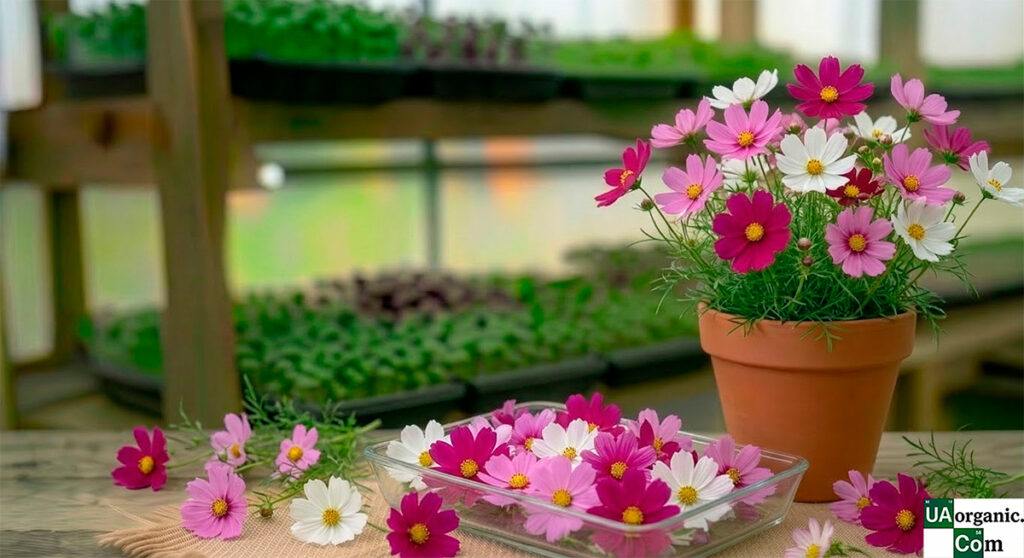
The flowers of the inflorescence are "baskets" with 7-8 broad tongue-shaped petals around a yellow or orange disc. Petals are thin, soft, delicate - silky to the touch. Flower size *C. bipinnatus* — 5–8 cm, one of the largest edible flowers in the catalog. This makes it a spectacular decoration for large dishes and cakes. *C. sulphureus* — somewhat smaller, 3–5 cm.
Safety & edibility
Edible flowers are not the same as florist flowers. Only flowers grown specifically for food use without synthetic pesticides are suitable.
- ✅ Petals and whole flowers - of both types
- ❌ Leaves are very bitter, do not use
- ❌ Stems - sharp smell and taste, do not use
- ❌ Seeds are not a culinary product
Are all varieties edible: Yes - all garden varieties C. bipinnatus and C. sulphureus edible This includes the popular Sensation, Sonata, Dazzler, etc. series. The taste differs minimally between the varieties - the color does not affect the taste.
Heat treatment: It is better not to heat fresh flowers - they wither and lose their color. For infusions, warm, but not boiling, brewing is permissible.
- Kosmeya belongs to the Aistrov family (Asteraceae) — people allergic to ragweed, chamomile or chrysanthemum should start with a small amount
- C. sulphureus bitterer - not recommended for dishes that require a delicate neutral decor
- Allergy to cosmeia is rare
- Pregnant women are recommended to use in moderation
This information is general in nature and is not medical advice. Sources: USDA FoodData Central, EFSA.
Culinary use
Cosmeia is primarily a decorative ingredient — large, delicate pink and purple petals C. bipinnatus provide one of the most elegant flower decorations among annual plants. Unlike small flowers (viola, balsam), cosmea is large enough to become the centerpiece of a presentation. For those who want a more pronounced taste - C. sulphureus with its spicy-bitter profile.
Fresh decor
a whole flower or individual petals are placed on the dish immediately before serving. Large size C. bipinnatus gives an impressive result with minimal effort.
Candy making
the petals are covered with egg white and fine sugar, dried. Pink and purple keep saturation for weeks.
Freezing in ice
a flower or petals in an ice form. The large size of the flower gives an expressive effect in the cube.
Insistence
petals in warm water give a delicate pink shade; for jelly and cocktails.
Infusion in syrup
petals are poured with hot sugar syrup (1:1); infuse for 30–60 minutes; a pink or white shade turns into syrup; for watering desserts and drinks.
Drying
the petals are laid out in one layer on parchment and dried at 35°C or in the shade; retain their shape and delicate pink color; used as a topping for desserts and tea mixtures.
- Do not buy flowers from florists and garden centers - systemic pesticides cannot be washed off
- Do not use the leaves and stems - they are very bitter and are not a culinary product
- Use for delicate decor C. bipinnatus, and not C. sulphureus — yellow-hot is more bitter and less neutral
Perfect pairings
panna cotta, mousse, cream cake, creme brulee - pink or purple petals on a white cream surface; one of the purest color contrasts.
strawberry, raspberry, fig, peach - warm pink-orange tones of cosmea support a warm berry range.
burrata, ricotta, goat cheese — large petals on top of white cheese with a drop of honey and nuts.
delicate pink flower C. bipinnatus on fresh fish serving - Scandinavian and Japanese aesthetics.
petals or a flower in an ice cube is one of the most spectacular color accents in a clear drink.
delicate pink petals of cosmea as a decoration on canapés with cream cheese or tartlets; a light floral aroma without a dominant taste.
How to select & store
- The flowers are bright, fully opened or at the beginning of opening — without wilting and darkening of the petals
- A plant grown without chemicals is a must
- C. bipinnatus for delicate decor; C. sulphureus for a spicy accent
Where to buy and grow: Cosmeia is one of the easiest edible flowers to grow. Seeds are cheap and available everywhere. Sow in the spring in open soil or a container - and flowering until frost is guaranteed. If you buy ready-made flowers - only from producers who grow them for food use.
Freshness after cutting: 2–3 days
- Fresh flowers — airtight container with a paper towel, refrigerator +4...+6°C, term 1–2 days
- Do not wash before use
- Candied petals - a dry place at room temperature, up to 2-4 weeks
Composition & properties
Detailed nutrient analysis for flowers Cosmos not published in USDA databases. The Aistrov family (Asteraceae), to which cosmea belongs, is well-studied for flavonoids and antioxidants.
| Nutrient | Value (per 100 g of fresh flowers) |
|---|---|
| Caloric content | ~25–35 kcal |
| Flavonoids (quercetin, kaempferol) | present — a typical profile of the Aistrovy family |
| Anthocyanins | present in pink and purple varieties C. bipinnatus |
| Carotenoids (β-carotene, lutein) | present in C. sulphureus - yellow-orange color |
| Polyphenols | are present |
| Essential oils | traces - a light herbal aroma |
| Vitamin C | traces |
| Calcium, Potassium | traces |
Cosmos bipinnatus is a native species of Mexico and Central America, where it was eaten before the arrival of the first Spaniards. Name Cosmos comes from the Greek "order, beauty" - it was given to the plant by the Spanish botanist Antonio José Cavani in 1791, impressed by the symmetry of the petals.
Kosmea came to Japan in the 1880s and became so ingrained in the culture that it became one of the basic flowers of the autumn landscape of Japanese literature and painting. In Tokyo's Hamarikyu district and in Saitama Prefecture, there are entire parks of kosmeia — millions of plants that bloom in October.
USDA FoodData Central data for flowers Cosmos not published as a separate line. Sources: Plants For A Future, scientific publications on Asteraceae.