When and how available
| the moon | Accessibility |
|---|---|
| January — May | ❌ Off season (open soil) |
| June | ✅ The beginning of flowering, the first umbrellas |
| July — August | ✅ Peak — mass flowering, best quality |
| September | ✅ The end of the season, the seeds are ripening |
| October — December | ❌ Not the season |
Dill can be grown in containers on the windowsill or in greenhouses year round, however, flowering in conditions of limited lighting is weaker. City farms with full lighting control are able to supply flower umbrellas out of season.
| Form | Features of use |
|---|---|
| fresh | The main form is the maximum aroma, the shelf life is 2–3 days |
| dry | For spicy dishes and marinades, the aroma is preserved well |
| Frozen | Suitable for hot dishes and sauces, decor is not suitable |
| Tincture / oil | Dill essential oils turn into oil, vinegar, alcohol |
Taste, aroma & texture
Classic dill with a distinct aniseed shade - the same taste that everyone recognizes from childhood, but softer and more floral compared to the leaves. There is a slight sweetness that the green lacks. The young green seed, which has not yet hardened, has the most intense flavor of all the edible parts of the plant.
One of the most recognizable kitchen aromas is a strong, aniseed-dill aroma caused by essential oils (carvone, limonene, phellandrene). The aroma of flower umbrella is rich, but not harsh: it is more floral and subtler than the aroma of mature seeds. It can be felt from afar - one bouquet of umbrellas can flavor the entire marinade.
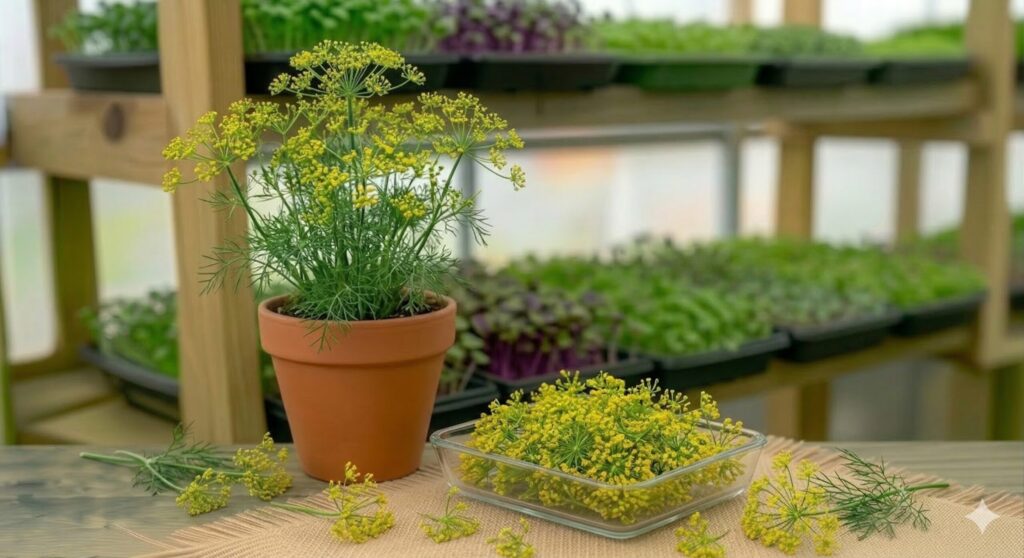
An umbrella consists of many small five-petalled flowers, collected in a complex umbrella inflorescence. Each individual flower is tiny, almost weightless, with delicate yellow-green petals. In the mouth, it is practically not felt physically, leaving only the aroma and taste.
Safety & edibility
Edible flowers are not the same as florist flowers. Only flowers grown specifically for food use without synthetic pesticides are suitable.
- ✅ Whole umbrellas (inflorescences)
- ✅ Individual flowers in the umbrella
- ✅ Young green seeds (until fully ripe)
- ✅ Stem (but tough, usually removed)
- ❌ Ripe hard seeds - hard, not eaten fresh (only as a dry spice)
Are all varieties edible: Yes - all cultural varieties Anethum graveolens edible Not to be confused with marsh dill (Oenanthe aquatica) - this plant is toxic. In the garden, they do not grow side by side, but it is important to distinguish when collecting wild plants.
Heat treatment: For fresh decoration, it is not recommended, the flowers will wither immediately. To flavor marinades and hot dishes - umbrellas are added to hot liquid, the aroma of essential oils is revealed when heated.
- Excessive use of dill essential oils is not recommended during pregnancy — it stimulates the contraction of the uterus in large doses (culinary amounts are safe)
- For people taking anticoagulants (blood thinners) - moderation due to the vitamin K content
- Allergy to plants of the umbrella family (Apiaceae): be careful if you are sensitive to carrots, celery or parsley
This information is general in nature and is not medical advice. Sources: USDA FoodData Central, EFSA.
Culinary use
The dill flower is unique in that it fulfills two roles at once: it is a full-fledged aromatic ingredient and at the same time an elegant decoration. Unlike most edible flowers, where the emphasis is on appearance, the umbel dill has traditionally been used primarily for its taste — and is only now appreciated as an aesthetic element of serving. In Ukrainian cooking, flower umbrellas of dill are an indispensable component of pickling cucumbers and pickles, where they give the marinade a characteristic aroma.
Fermentation and salting
umbrellas of dill are placed in a jar together with cucumbers, garlic and horseradish. The essential oils of flower umbrellas take an active part in forming the flavor of the marinade — this is a traditional Ukrainian technique.
Drying
umbrellas are hung with the inflorescence down in a dry, ventilated place. Dry umbrellas retain their aroma for months and are used in marinades and hot dishes.
Infusion in oils and vinegars
fresh umbrellas are poured with olive oil or apple cider vinegar and insisted for 2-3 weeks. Aromatic base for dressings and marinades.
Compound butter
dill flowers and greens are crushed and mixed into soft butter along with lemon zest. Finishing of hot dishes and spread for toasts.
Fresh decor
a whole inflorescence of dill or individual sprigs is placed on the dish immediately before serving; the aroma is concentrated, so one flower is enough for a serving.
Freezing in ice
inflorescences in an ice form with water; spectacular presentation of Scandinavian and Mediterranean dishes with seafood and cold drinks.
- Do not add fresh umbrellas to a hot dish immediately before serving - at a temperature above 80°C, they immediately wither and turn black; add at the very last moment or after removing from heat
- Do not store fresh umbrellas for more than 2-3 days - they quickly lose their aroma and turn yellow; order or cut immediately before use
- Do not wash under a strong jet - the delicate flowers will fall off; dip the umbrella into a bowl of cold water and shake gently
- Do not replace flower umbrellas with dry dill when pickling - dry dill gives a less distinct aroma; it is the fresh or dried umbel (not the powder) that is the correct ingredient
Perfect pairings
salmon, cod, herring, trout, zander - dill and fish are one of the most classic culinary combinations. A flower umbrella looks more refined than greenery and gives the same aromatic effect.
boiled new potatoes, potato salad, horseradish - an umbrella of dill turns a simple dish into a seasonal delicacy with a visual and aromatic accent.
flower umbrellas of dill are a key ingredient of pickles in the Ukrainian tradition. Parasol essential oils flavor the marinade and participate in the fermentation process.
poached eggs, frittata, scrambled eggs, egg salad - dill and eggs naturally complement each other, and the flower adds sophistication to an ordinary breakfast.
sour cream, ryazhanka, cream cheese, soft cheese - the dill aroma penetrates the creamy base without interrupting it.
dill flowers on toast with Scandinavian salmon, herring or cream cheese is a classic Nordic decoration that emphasizes the freshness of the dish.
How to select & store
- The flowers are open, yellow-green, without yellowing or wilting
- The aroma is distinct, pure dill - without extraneous odors
- The stem is elastic, not soft and not slippery
- There are no signs of insects, damage or mold
Where to buy is important: Buy edible dill flowers only from proven producers who grow them specifically for the food industry, or from your own garden without the use of chemicals. Dill from the market or store can be treated with plant protection products.
Freshness after cutting: 2–3 days
- Fresh umbrellas - put in a glass of cold water as a bouquet, refrigerator +4...+6°C, term 2–3 days
- Or wrap in a damp paper towel in a sealed container
- Do not wash before use - moisture accelerates wilting and shedding of flowers
- For the restaurant: Cut or order directly on the day of serving
Composition & properties
Flower umbrellas of dill, like greens, contain essential oils that determine their characteristic aroma and taste. The chemical profile includes carvone, limonene, and phellandrene—compounds that form the recognizable dill flavor and are the subject of research for their antibacterial properties.
| Nutrient | Value (per 100 g of fresh greens / flowers) |
|---|---|
| Caloric content | ~43 kcal |
| Vitamin C | ~85 mg (≈94% of daily norm) |
| Vitamin A (beta-carotene) | ~386 μg |
| Vitamin K | ~55 μg |
| Calcium | ~208 mg |
| iron | ~6.6 mg |
| Flavonoids (quercetin, kaempferol) | are present |
| Essential oils (carvone, limonene, phellandrene) | are present - the basis of the aroma |
Dill has traditionally been used in folk medicine as a digestive aid - essential oils stimulate the secretion of digestive enzymes. These properties also apply to flower umbrellas. Dill flavonoids (quercetin, kaempferol) are the subject of research in the context of antioxidant activity.
In Ukrainian folk tradition, dill flower was used in fermentation not only as a flavoring ingredient, but also as a natural preservative — essential oils suppress the growth of unwanted bacteria during fermentation.
Exact data for umbel flowers are not separately standardized - the values are approximate based on data for green dill. The information is general in nature and does not constitute medical advice. Data: USDA FoodData Central.