When and how available
| the moon | Accessibility |
|---|---|
| January — May | ❌ Not the season |
| June | ✅ Beginning of flowering |
| July — August | ✅ Peak - abundant flowering, best quality |
| September | ✅ The end of the season |
| October — December | ❌ Not the season |
City farms can grow evening primrose indoors, but it is mostly a seasonal crop in open ground.
| Form | Features of use |
|---|---|
| fresh | The main form — maximum aroma, duration 1–2 days |
| dry | For tea and infusions, the aroma is preserved well |
| Kandovan | Decor of desserts and cakes |
| Syrup | Honey-flower syrup for drinks and desserts |
| Pickled buds | Young buds are pickled like capers |
Taste, aroma & texture
Soft, sweet with a light honey-lemon note. The flowers have a thinner and more delicate taste than the leaves - the leaves are slightly bitter and more like greens. Buds are more delicate than open flowers and taste best fresh.
Gentle, sweet-floral with a hint of honey. It opens in the evening - in the morning the plucked flowers smell weaker. The aroma is subtle, not intense, well conveyed in syrups and infusions.
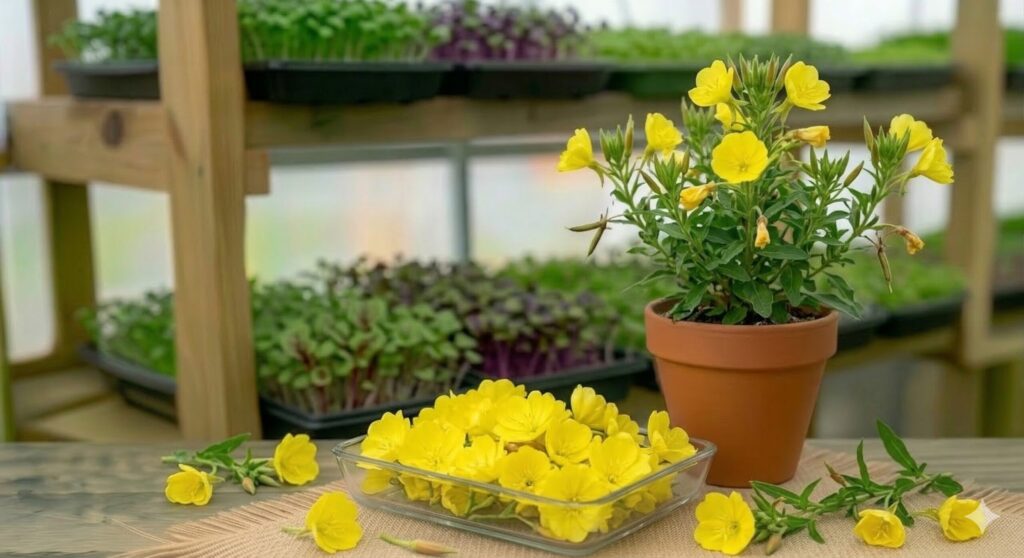
Four rounded petals, thin and silky. Very tender, melts immediately. The cross-shaped shape of the flower gives a clean geometric look when served — especially impressive after canding. ---
Safety & edibility
Edible flowers are not the same as florist flowers. Only flowers grown specifically for food use without synthetic pesticides are suitable.
- ✅ Flowers and petals
- ✅ Buds — tender, fresh or pickled
- ✅ Young leaves (slight bitterness - like spinach)
- ✅ Roots of the first year - boiled or baked (parsnip-like taste)
- ✅ Young shoots are like greens after blanching
- Evening primrose seed oil is a well-known dietary supplement; seeds are not used for cooking
- Leaves in large quantities may be mildly laxative — moderate consumption
- When using for the first time, start with a small amount
This information is general in nature and is not medical advice. Sources: USDA FoodData Central, EFSA.
Culinary use
Evening primrose is a bright yellow decor and a delicate aromatic accent. The flowers look beautiful in salads due to their clear cross-shaped shape and pure yellow color. The taste is delicate - it does not compete with other ingredients, but complements them. It is especially appropriate in summer dishes and drinks.
collection
collect in the evening or early in the morning before the flower closes; daytime closed flowers are not suitable for serving.
Candy making
egg white and fine sugar, drying at 40°C; the cross-shaped shape is perfectly preserved.
Syrup
flowers in a ratio of 1:1:1 (flowers:sugar:water), infuse for 12–24 hours without heating, filter. Store in the refrigerator for 2 weeks.
Drying
at 35–40°C in the dryer or in the shade; for tea and infusions.
Fresh decor
a whole inflorescence or individual petals are placed on the dish immediately before serving; flowers open in the evening and quickly close in the morning, so picking and serving is in the evening hours.
Freezing in ice
a flower in a mold for ice cubes with distilled water; pale yellow color is preserved after freezing; spectacular decor in cocktails and lemonades.
- Do not pick flowers during the day, when they are closed - the aroma and marketability are lost
- Do not confuse with decorative primroses (Primula) — different genera; Evening primrose has four petals, primrose has five
- Do not store for more than 1-2 days - very delicate; collect for a specific use
- Do not use leaves in large quantities - mild laxative effect if consumed in excess
Perfect pairings
ricotta, cream cheese, mozzarella — the honey-lemon note of the flower emphasizes the creaminess and refreshes the neutral base.
natural taste kinship - together form the basis for summer desserts, toasts and yogurt parfaits.
strawberry, raspberry, currant - the yellow flower contrasts with the color and complements the berry tart with its sweetness.
lemonade, cold tea, prosecco - a flower as a decoration and a light aroma; evening primrose syrup as a base for cocktails.
delicate floral sweetness without spiciness goes well with delicate seafood - scallops, white fish.
panna cotta, vanilla mousse, crème brûlée — delicate yellow evening primrose flower as decoration on a light background; delicate aroma does not interrupt the creamy base.
How to select & store
- The petals are elastic, bright yellow, without darkening
- The flower is fully opened (picked in the evening or early morning)
- The aroma is gentle, honey-floral
- The center of the flower is dry
Where to buy: Only from proven producers of edible flowers or from your own garden without chemical treatment. Evening primrose grows easily in any area - it is a biennial plant that blooms profusely in the second year.
Storage:
- Fresh flowers — in a paper towel, airtight container, refrigerator +4°C, term 1–2 days
- Do not wash before use
- For long-term storage — drying or candiing immediately after collection
Freshness after cutting: 2–3 days
Composition & properties
Evening primrose is primarily known for its seed oil, one of the richest plant sources of gamma-linolenic acid (GLA). Flowers and leaves have a more modest but pleasant nutrient profile.
| Nutrient | Value (per 100 g) |
|---|---|
| Caloric content | ~30–40 kcal |
| Vitamin C | traces |
| Vitamin A (beta-carotene) | the yellow pigment of the petals is present |
| Flavonoids (quercetin, kaempferol) | ~2–4 mg/g (dry content) |
| Polyphenols (gallic acid, ellagic acid) | are present |
| Tanning substances | are present |
| Mucous polysaccharides | are present - mitigating action |
| Potassium, Calcium, Magnesium | traces |
Evening primrose seed oil is a well-known dietary supplement and the subject of numerous studies (source of GLA - omega-6 fatty acid). The flowers and leaves of the plant have been used for food since ancient times - the indigenous peoples of North America used all parts of the plant as food.
The information is general in nature and does not constitute medical advice. Composition data: USDA FoodData Central.