When and how available
| the moon | Accessibility |
|---|---|
| January — April | ❌ Not the season for growing outdoors |
| May — June | ✅ The beginning of flowering, the first flowers |
| July — September | ✅ Peak - abundant flowering and the first berries at the same time |
| October | ✅ Continues to bloom until frost |
| November — December | ❌ Not the season |
Fuchsia is a frost-sensitive plant; in the open soil of a temperate climate, the season is short. City farms and winter gardens can grow fuchsia year round. Indoor fuchsia blooms almost continuously with sufficient lighting.
| Form | Features of use |
|---|---|
| fresh (flowers) | Decor and sour accent in cold dishes; period of 2-3 days |
| fresh (berries) | The main culinary form for berries; they are used ripe - dark and soft |
| Frozen (flowers and berries) | For cocktails and desserts; Freezing preserves color and flavor |
| Candovana (flowers) | Cakes and pastries - the hanging form of the flower is preserved well |
| Jam and jelly (berries) | Traditional use in the area of origin of the plant |
| Syrup (flowers and berries) | For cocktails and lemonades — a rich crimson-pink color |
Taste, aroma & texture
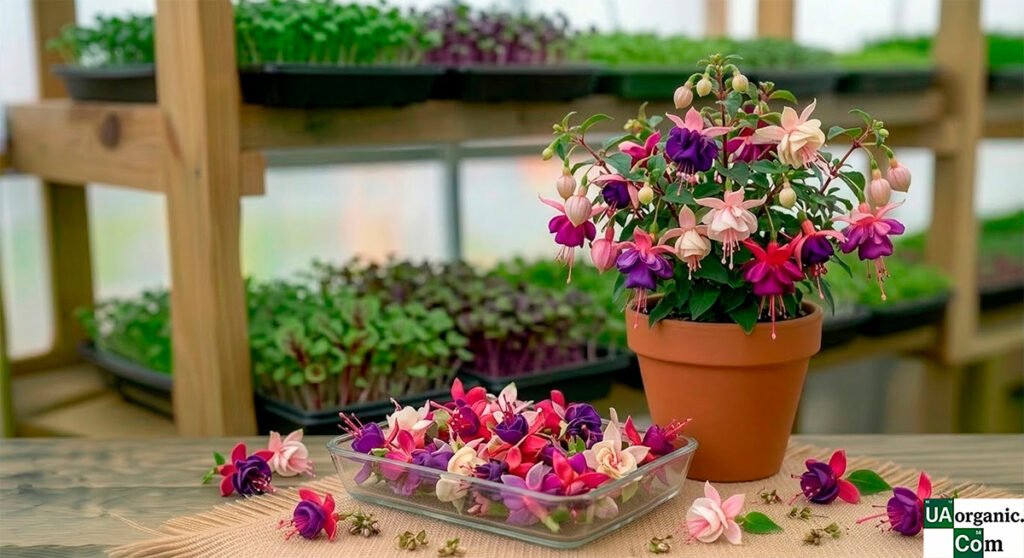
The flowers have a slightly sour and tart taste with a floral note - Gardener's Path describes it as "slightly bitter and subtly sour" for those who like bold flavors. The inner petals are softer and sweeter, the outer sepals are tarter. Berries are a completely different story: sweet and sour, with a sub-acid character, reminiscent of a mixture of figs, kiwi and black currants. Darker berries are sweeter, paler ones are more sour. Some varieties have a light peppery shade in the berries.
The flowers have a gentle, subtle floral aroma — unobtrusive, felt upon direct contact. Berries smell juicier - a sweet berry, slightly currant aroma. In general, this is a plant where taste is more important than aroma.
The flowers are tubular, complex in shape — four long wrapped sepals and four shorter inner petals. Thin, with a pleasant chew. Berries are small, juicy, with many small seeds - similar in texture to currants or small blueberries; the seed is soft and does not interfere.
Safety & edibility
Edible flowers are not the same as florist flowers. Only flowers grown specifically for food use without synthetic pesticides are suitable.
- ✅ Flowers and petals are edible, acidic decor
- ✅ Ripe berries are edible, the main culinary value for fruit dishes
- ✅ Leaves - edible in small quantities, spicy pepper taste; large amounts can cause stomach discomfort
- ❌ Immature berries - starchy, can cause a slight disorder; use only fully ripe ones
- ❌ Stems and roots are not used
Are all varieties edible: All varieties of the genus Fuchsia are considered non-toxic. Most hybrids have edible flowers and berries, but the taste varies significantly. The tastiest berries come from specially bred edible varieties and species: F. boliviana, F. excorticata, F. splendens, F. regia, variety "Fuchsiaberry". Decorative hybrids have edible, but often fresh or sour berries.
Attention: "California fuchsia" (Epilobium canum, Willowherb family) is not a true fuchsia, despite the name. This is a different plant.
Heat treatment: Flowers - cold service only. Berries tolerate heat treatment: jam, jam, compote, syrup, sauce for desserts.
- Leaves in large quantities can cause mild stomach discomfort - use as a condiment, not as a main herb
- Unripe berries are starchy and can cause nausea - use only fully ripe (dark and soft)
- When using for the first time, start with a small amount - individual sensitivity is possible
- Pregnant women should use it sparingly
This information is general in nature and is not medical advice. Sources: USDA FoodData Central, EFSA.
Culinary use
Fuchsia is a rare case where the edible flower is only half the culinary value of the plant. The flowers provide a spectacular decoration - the hanging "earring" shape is one of the most recognizable among all flowers - and a sour taste accent. But berries open a completely different horizon: a complete fruit ingredient with a sweet-sour taste for jam, syrups, dessert sauces and cocktails. This is a plant for the chef, who is looking for not just a decoration, but a real gastronomic surprise for the guest.
Freezing in ice
a whole flower in an ice cube tray with distilled water; the fuchsia pendant form gives maximum effect in a transparent cube.
Candied flowers
the flowers are covered with egg white and fine sugar, dried. The complex shape of fuchsia requires precision, but the result is one of the most spectacular in the confectionery.
Berry syrup
ripe berries are boiled with an equal amount of sugar and water for 10–15 minutes, filtered. Raspberry-pink syrup with a sweet-sour taste can be stored in the refrigerator for up to 2 weeks.
Freezing berries
berries are frozen in one layer, then poured into a bag. Stored until the next season. Taste and color are preserved well after defrosting.
Insisting in alcohol
flowers and berries are infused in vodka or gin for 1–2 weeks. The liquid acquires a crimson color and a floral aroma.
Berry jam and jelly
ripe berries are cooked with sugar and apple pectin; jelly has a sweet-sour taste and a delicate pink color; a traditional recipe from New Zealand and Bolivia.
- Do not buy fuchsia in flower shops or garden centers for consumption - decorative plants are treated with protective agents and are not suitable for food use
- Do not eat unripe berries - pale pink or green berries are starchy and can cause nausea; only dark, soft, fully ripe ones
- Do not use leaves in large quantities - as a separate ingredient in large quantities can cause discomfort in the stomach; a few leaves as a seasoning is safe
- Do not add flowers to hot dishes - the petals lose their color and shape when heated; berries for hot dishes - ok, flowers - only cold serving
Perfect pairings
panna cotta, vanilla mousse, rice pudding, cheesecake - a crimson-purple hanging flower on a light background gives the maximum decorative effect; sourness contrasts with the creamy base.
strawberry, raspberry, blueberry, peach - fuchsia berries fit into the berry range and add an unfamiliar sweet-sour tone; an unexpected ingredient in familiar dishes.
gin and tonic, prosecco, lemonade - a flower in an ice cube or on the edge of a glass, berries at the bottom as a natural dye and taste accent; the crimson-purple color of the berries colors the drink.
ricotta, mascarpone, cream cheese - sweet and sour berries instead of or together with currants or cranberries; unusual texture couple.
the acidity of fuchsia flowers works as a substitute for lemon juice in the form of decoration - for tartares, carpaccio and ceviche.
fuchsia berries and pieces of dark chocolate 70%+ — sour berry acidity balances the bitterness of chocolate; for cakes, truffles and chocolate mousse.
How to select & store
- Sepals and petals are elastic, the color is saturated - crimson, pink, purple, white or two-color
- The flower is hung naturally, does not wither
- Without traces of damage and extraneous odors
- Dark purple or almost black, depending on the variety
- Soft to the touch, but does not spread
- Juicy when cut; no signs of mold
Where to buy is important: Buy edible fuchsia only from proven producers, grown specifically for the food industry. Fuchsia in garden centers is a decorative product without food control.
Freshness after cutting: 2–3 days
- Fresh flowers — airtight container with a paper towel, refrigerator +4...+6°C, term 2–3 days
- Ripe berries - in the refrigerator for up to 5 days; frozen - up to 12 months
- Do not wash the flowers before use - moisture accelerates wilting
- For a restaurant: order flowers for a specific day, berries — you can have a reserve
Composition & properties
Fuchsia flowers have been studied for their anthocyanin content; berries - more widely, including vitamin C and antioxidants. There is no detailed USDA FoodData Central data for fuchsia, but scientific publications (including Rop et al., 2012) confirm the presence of active compounds.
| Nutrient | Value (per 100 g of fresh flowers) |
|---|---|
| Caloric content | ~15–25 kcal |
| Anthocyanins | ~50–200 mg — gives a crimson-purple color (Rop et al., 2012) |
| Flavonoids and polyphenols | ~0.5–2% of dry weight |
| Vitamin C | ~10–20 mg |
| Organic acids | ~1–3% of the raw mass — forms a sour taste |
| Fiber | ~1–2 g |
Fuchsia is a plant with a thousand-year culinary tradition in Central and South America. The Quechua people (Incas) used the berries F. boliviana and still sell them in the traditional markets of Bolivia, Ecuador and Peru. The Maori of New Zealand traditionally ate berries of a local species F. excorticata — kotukutuku, which is one of Aotearoa's few deciduous trees. In New Zealand, there is even a traditional saying about the flowering time of this tree as a marker of the beginning of spring.
Anthocyanins, which give flowers their characteristic crimson-purple color, are the subject of scientific research in the context of antioxidant properties. A study by Rop et al. (2012) confirmed the high content of anthocyanins in the flowers of fuchsia garden hybrids.
There is no detailed USDA FoodData Central data for fuchsia. Data on anthocyanins: Rop O. et al., Journal of Medicinal Plants Research, 2012 (PMC). Culinary Use Data: Gardener's Path; Cornucopia II (Facciola, 1990). The information is general in nature and does not constitute medical advice.