When and how available
| the moon | Accessibility |
|---|---|
| January — April | ❌ Out of season (open ground, frost-sensitive plant) |
| May — June | ✅ Beginning of flowering after sowing in warm weather |
| July — September | ✅ Peak — abundant flowering, maximum concentration of spilanol |
| October | ✅ Completion of the season before the first frost |
| November — December | ❌ Not the season |
Climate-controlled urban farms can grow spilanthe year round — the plant develops well in conditions of closed soil and is not tied to the season with sufficient lighting and warmth.
| Form | Features of use |
|---|---|
| fresh | The main form is the maximum sensory effect, the term is 3-5 days in the refrigerator |
| Frozen | Freezing practically does not affect the level of spilanol - the effect is completely preserved |
| dry | The effect is weaker, but suitable for cocktail rims and decor |
| Tincture / extract | Spilanol is extracted into alcohol; concentrated effect for cocktails and foams |
Taste, aroma & texture
Grassy, lemony, tingling - the first seconds are a soft grassy taste with a lemon note, then Spilanol triggers tingling, numbness and increased salivation for 5-15 minutes. The effect is reminiscent of Pop Rocks, but stronger and without gas - this is not a taste in the usual sense, but a sensory experience.
Grassy, lemony, neutral — faintly floral-grassy, slightly citrusy. Aroma is not the main thing; everything important happens in the mouth after the bite, not before it.
Dense, chewy, juicy - button inflorescence is much denser than most edible flowers. Requires a bite to release spilanol. The flower is served whole - just chewing it triggers the whole effect.
Safety & edibility
Edible flowers are not the same as florist flowers. Only flowers grown specifically for food use without synthetic pesticides are suitable.
- ✅ Inflorescence ("button" flower) is the main edible part
- ✅ Buds
- ✅ Leaves (grassy spicy taste, used in salads and as greens)
- ✅ Young stems - after a short blanching
- ❌ The root is not used
Are all varieties edible: All cultivated forms Acmella oleracea are considered edible. The wild form with a higher concentration of spilanol is also edible, but its effect is more severe. Decorative plants of the genus Acmella and similar species from the aster family (Asteraceae) — do not use without confirmed identification.
Heat treatment: Spilanol is partially destroyed when heated — the effect weakens. The flowers are served fresh or added to the dish after cooking. The leaves can be cooked - they lose their sharpness and are used as greens.
- The tingling and numbness effect is a normal reaction to Spilanol - not an allergy
- For people with sensitivity to plants of the family Asteraceae (chamomile, chrysanthemum, ambrosia) should start with a very small amount
- Pregnant - use moderately, without excess; there are not enough specific studies for this group
- The flower increases salivation — take into account when serving to guests without warning; it is better to explain the effect in advance
This information is general in nature and is not medical advice. Sources: USDA FoodData Central, EFSA.
Culinary use
Spilanthe is the only edible flower where the main value is not the taste or color, but the physiological effect. Spilanol increases salivation and increases the sensitivity of the taste buds - that's why the food or drink that comes after spilante is perceived brighter and richer. Chef Ferran Adrià, one of the first to use it in haute cuisine, called this property "preparation of the mouth for taste". At the bar, the spilante makes the cocktail come alive — it doesn't just decorate the glass, it changes how the guest perceives the drink.
Serving as a whole flower
a classic: the guest bites the button himself. A warning about the effect enhances, not diminishes, the impression—the intrigue is part of the delivery.
Insisting in alcohol
flowers are poured with vodka or gin for at least a week in a dark place. The tincture contains concentrated spilanol and is used for cocktails and foams; effect without plant mass in the mouth.
Freezing in ice
a flower in an ice cube for cocktails: the effect is released gradually while the ice melts.
Drying and crumbs for rims
dried flowers are crushed and mixed with salt or sugar to sprinkle the rim of the glass; every sip is accompanied by a slight tingling sensation.
Oil or butter
the petals are infused in neutral oil; gives a weaker effect than a fresh flower, but is evenly distributed in the dish.
Maceration in juice or vinegar
flowers are poured with lemon juice or apple cider vinegar for 15–30 minutes; active substances turn into a liquid; "electric" cocktail or dressing with sensory effect.
- Do not buy spilante in flower shops or ornamental nurseries - a plant grown without food control is not suitable for consumption
- Do not serve to guests without warning about the effect - numbness and tingling can scare a person who does not know what to expect; a brief explanation is part of the submission
- Do not add to hot dishes - heating destroys spilanol, and you lose the main purpose of this flower
- Do not separate the inflorescence into petals - spilanthe is eaten as a whole button: it is the dense structure that releases spilanol when chewed
Perfect pairings
gin and tonic, margarita, spritz, lemonade - spilanol enhances citrus acidity and makes the drink more "electric"; tingling and acid reinforce each other.
oysters, scallops, tuna tartar, ceviche - the flower triggers salivation and prepares the receptors just before a dish with a delicate sea taste; classics in Scandinavian and Japanese fusion cuisine.
spilanol partially suppresses the perception of spiciness - the flower serves as a "buffer" between the spice and the receptors, making spicy dishes more controlled by sensations.
spilante tincture or extract is mixed into foam — the guest gets the effect without having to chew the whole flower; molecular kitchen technique.
ricotta, cream cheese, labneh — a clean background makes it possible to fully experience the sensory effect without competing flavors.
spilantes as an "electric" accent in beer appetizers and snacks; the tingling sensation intensifies the bitterness of hops and prepares the receptors for the next sip.
How to select & store
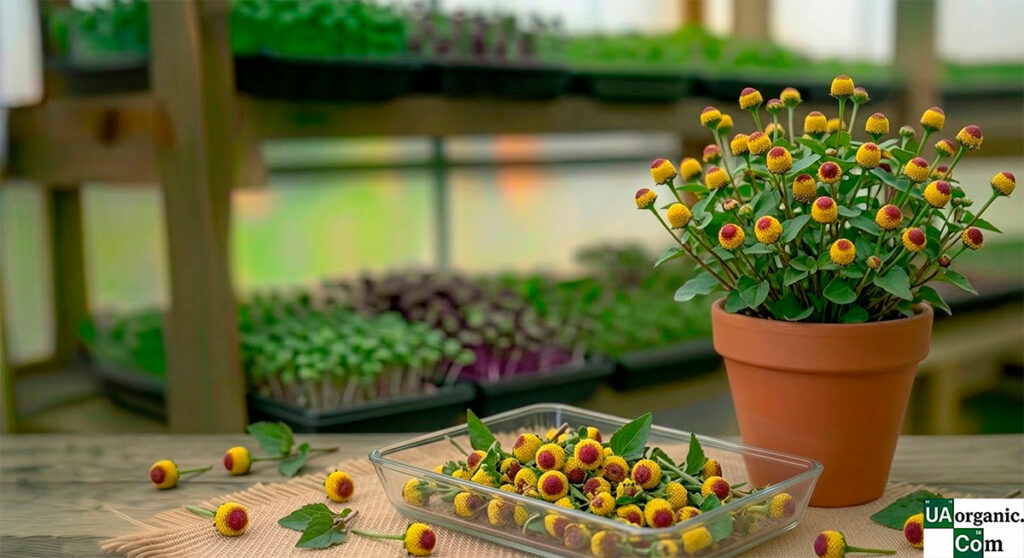
- The inflorescence is hard, elastic, the shape of the "button" is preserved
- The color is bright: yellow-orange with a clear dark red center
- No signs of wilting, slime or darkening
- The smell is grassy, neutral - without extraneous
Where to buy is important: Buy spilante only from proven producers, grown specifically for the food industry. An ornamental plant from the garden center is not an edible option, even if it looks good on the outside.
Freshness after cutting: 2–3 days
- Fresh flowers — airtight container with a paper towel, refrigerator +4...+6°C, term 3–5 days
- Frozen - in a bag without access to air; the effect remains almost completely after defrosting
- Do not wash before use - moisture accelerates wilting
- For restaurants and bars: due to the longer term compared to other flowers, spilante can be ordered a week in advance
Composition & properties
Spilanthe is one of the few edible flowers whose active substance, spilanol, has been well studied scientifically. EFSA and JECFA have assessed the safe daily intake of spilanol as a food flavoring; in culinary amounts (1–3 flowers per serving), the plant is considered safe for most people.
| Nutrient / substance | Value (per 100 g of fresh flowers) |
|---|---|
| Caloric content | ~20–35 kcal |
| Spilanol (N-isobutylamide) | ~0.5–1.5% of raw mass; ~70–80% of alkylamides |
| Flavonoids and phenolic compounds | ~0.5–2% of dry weight |
| Carotenoids (beta-carotene) | ~0.5–1.5 mg |
| Vitamin C | ~15–30 mg |
| iron | ~1–2 mg |
| Calcium | ~50–100 mg |
Spilanthe is a plant with a thousand-year history of use in the traditional cooking of Brazil, India and Madagascar. In the Amazon, leaves and flowers are used in national dishes. In India, the plant is traditionally used as a spice.
Spilanol, which is responsible for the sensory effect, is the subject of active scientific research. It interacts with the trigeminal nerve - the same one that reacts to chili pepper and menthol, but by a completely different mechanism. It is this property that makes the spilante a unique tool in the hands of chefs and bartenders.
The plant also contains flavonoids and phenolic compounds, which are the subject of research in the context of antioxidant properties.
There is no detailed USDA FoodData Central data for spilante flowers individually. Spilanol data: EFSA Scientific Opinion on Spilanthol (FGE.303), USDA FoodData Central.