When and how available
| the moon | Accessibility |
|---|---|
| January — May | ❌ Not the season |
| June | ✅ Beginning of flowering of early varieties |
| July — August | ✅ Peak - abundant flowering, the best quality and aroma |
| September — October | ✅ Late varieties continue to bloom until the first frost |
| November — December | ❌ Not the season |
Phlox is a typical summer flower with a natural season of July-September. City farms with controlled climate and lighting can grow it year round as an off-season product.
| Form | Features of use |
|---|---|
| fresh | The main form is maximum aroma and color; period of 3–5 days |
| Kandovan | Cakes and pastries - crystallized sugar emphasizes the shape of small flowers; classic usage |
| dry | For floral teas and decor; the aroma is partially preserved |
| Frozen in ice | Cocktails and lemonades - a separate flower from an inflorescence in a transparent cube |
Taste, aroma & texture
Tender, slightly spicy and sweet, several sources compare it to sugar snap peas. Garden Gate Magazine and The Flower Deli describe the taste as "slightly spicy and sweet". It is not a pronounced taste that changes the dish - it is a light pleasant accent that does not compete with the main ingredients. Some samples are almost neutral; with flowers of dark varieties (raspberry, purple), the taste is somewhat more intense.
One of the most expressive among edible flowers - intense, sweet, floral-honey. It is the aroma of phlox, not the taste, that is the main culinary value. It can be felt from afar and is stored at room temperature. In a cold dish, the aroma is more restrained, in a warm dish, it is fully revealed. Use the aroma of phlox as the first "hit" when serving - the guest feels it before the first bite.
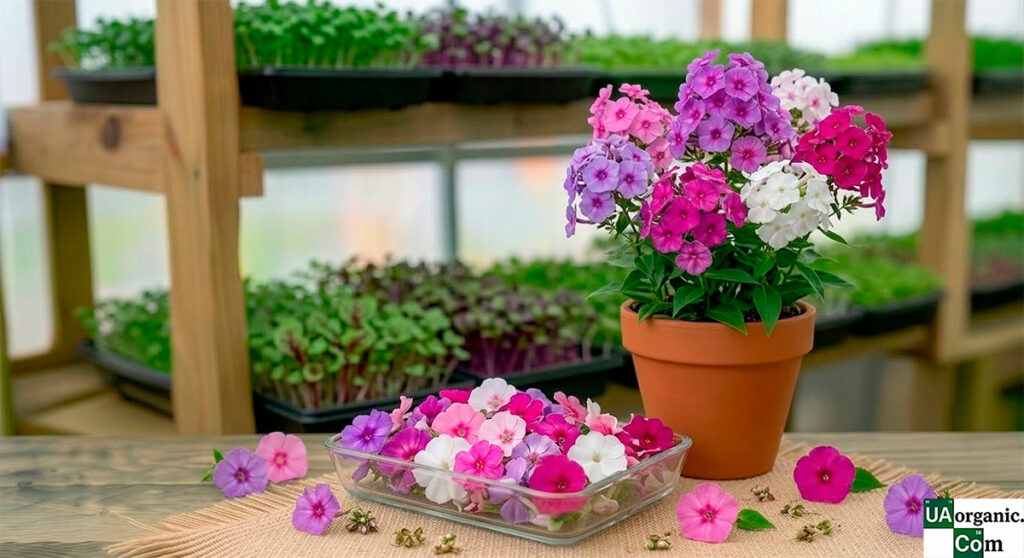
Each flower in the inflorescence is small - about 1 cm in diameter - tubular, with five fused petals. Thin and tender, melts in the mouth. Whole inflorescences are not used for presentation - individual flowers are separated. The central tube of the flower is denser - it can be removed if desired.
Safety & edibility
Edible flowers are not the same as florist flowers. Only flowers grown specifically for food use without synthetic pesticides are suitable.
- ✅ Individual flowers from the inflorescence are the main edible and decorative part
- ✅ Petals
- ⚠️ Leaves - formally edible in small quantities, but hardened and practically not used in cooking
- ❌ Stems and roots are not used
- ❌ A whole inflorescence - for serving, disassemble it into separate flowers
Are all varieties edible — CRITICAL:
| Edition | height | Edibility |
|---|---|---|
| Phlox paniculata (garden phlox) | 80–120 cm | ✅ Edible |
| Phlox subulata (slender phlox) | 10–15 cm | ❌ Not edible |
| Annual phloxes (P. drummondii) | 20–40 cm | ❌ Not edible |
Rule of thumb for field identification: If the plant is low and creeping on the ground, it is a slender phlox, do not use. If the plant is one-year old and stunted, do not use it. Edible phlox - only tall perennial up to 120 cm with large dense inflorescences. Buy only from a verified food manufacturer with a confirmed species.
Heat treatment: Not recommended for petals - they lose their color and aroma. Only cold serving or finishing decoration.
- When using for the first time, start with a small amount - individual sensitivity is possible
- A large number of leaves can cause a slight upset stomach - in culinary quantities (individual flowers) this is not relevant
- Pregnant women should use it sparingly
- For people with hay fever and pollen allergy, it should be introduced gradually into the diet
This information is general in nature and is not medical advice. Sources: USDA FoodData Central, EFSA.
Culinary use
Phlox is a flower for those who value aroma as part of the gastronomic experience. Most edible flowers in the finished dish practically do not smell - phlox smells both on the plate and from afar. This makes it possible to build a dish around an aromatic and not just a visual impression. At the same time, the taste is soft enough not to overpower the main ingredient. In terms of the size and volume of the inflorescence, phlox wins over most edible flowers - one sprig of inflorescence turns the presentation from "decorative" to "flower".
Dissecting the inflorescence
phlox inflorescences are not served whole; individual flowers are separated with tweezers or by hand. Flowers that have not fully opened are laid aside.
Candy making
individual flowers are covered with egg white and fine sugar, dried. The small size requires accuracy and work with tweezers. The aroma is partially preserved when candied. Stored for weeks.
Freezing in ice
a separate flower in an ice cube tray with distilled water; the pink or purple color of phlox is well read in a transparent cube.
Drying
the inflorescences are dried in the shade between sheets of paper. The aroma is partially preserved; used in floral tea mixtures.
Insistence
phlox flowers are infused in neutral vodka or gin; get an aromatic tincture for cocktails and syrups.
Fresh decor
separate flowers or a small phlox inflorescence are placed on the dish before serving; juicy colors from white to deep purple make them a spectacular accent.
- Do not buy phlox in flower shops and garden centers without a confirmed species P. paniculata — slanky and annual phlox look similar to the untrained eye, but are not edible
- Do not use a whole inflorescence for serving on a plate - it is bulky and impractical; disassemble into separate flowers
- Do not add to hot dishes - the petals instantly lose their color and aroma when heated; exclusively served cold
- Do not keep cut inflorescences for more than 5 days - after that the flowers begin to fall and wither; order for a specific serving
Perfect pairings
panna cotta, vanilla mousse, meringue, rice pudding - the aroma of phlox over a cold creamy background gives the effect of a "flower garden"; pink or purple phlox on a white surface is a win-win.
peach, strawberry, raspberry, watermelon - specifically mentioned in several sources as an ideal combination; the floral sweetness of the phlox enhances the berry.
cakes, cupcakes, tarts - candied phlox is a classic for those who need a voluminous aromatic decor instead of a tasteless one; the small size of the flowers is convenient for detailed decoration.
floral lemonade, gin and tonic, prosecco - phlox flowers on the surface of the drink give both aroma and color; one of the best options for flavored sparkling drinks.
delicate inflorescences of phlox in an ice cube or on the edge of a glass; pink, white or purple color is a spectacular decoration in drinks without a distinct taste.
phlox flowers as a colorful decoration in cold fish dishes; a bright pink or lilac note on a neutral background of salmon or tuna.
How to select & store
- The inflorescence is dense, most of the flowers are fully opened
- The color is uniform and saturated - without yellowing and stains
- The aroma is pronounced and pleasant — floral-sweet without extraneous odors
- Without signs of wilting and falling flowers
Where to buy is important: Buy phlox only from proven growers Phlox paniculata especially for the food industry. Phlox in flower shops and garden centers is a decorative product without food control and often without a confirmed species.
Freshness after cutting: 2–3 days
- Fresh inflorescences — in a glass of water as a bouquet or in an airtight container with a paper towel, refrigerator +4...+6°C, term 3–5 days
- Do not wash before use - moisture accelerates the fall of small flowers
- Separate the florets into florets just before serving
- For a restaurant: you can order a few days in advance, but it is better - for a specific day of service
Composition & properties
There is no detailed USDA FoodData Central data for phlox flowers—the plant is used in culinary amounts that do not make a significant nutritional contribution. Scientific studies of phytochemical composition P. paniculata limited It is known that the plant was traditionally used by the indigenous peoples of North America - Algonquin, Cherokee and other tribes - in folk medicine.
| Nutrient | Value (per 100 g of fresh flowers) |
|---|---|
| Caloric content | ~10–20 kcal |
| Flavonoids | ~0.5–1.5% of dry weight |
| Anthocyanins (pink/purple varieties) | ~20–80 mg/100 g |
| Essential oils | ~0.01–0.05% of the raw mass is the main culinary value |
| Tanning substances | ~1–3% of dry weight |
Phlox paniculata — a plant originating from the eastern states of North America. Native peoples — in particular the Cherokee — traditionally used various parts of the plant in folk medicine. Phlox entered modern culinary practice as an element of the "edible floral" trend that blossomed in restaurant kitchens in the 2010s.
The main culinary value is not nutrients, but aroma. Essential oils, which give phlox a characteristic sweet floral smell, are preserved in fresh flowers and partially - during candiing and drying. Anthocyanins are responsible for the pink, mauve and purple color of varieties and are the subject of general research in the context of antioxidant properties.
Detailed USDA FoodData Central data for P. paniculata there is no Culinary information: Green Deane, Eat the Weeds; Garden Gate Magazine; The Flower Deli; What's Cooking America - Edible Flowers Chart. The information is general in nature and does not constitute medical advice.