When and how available
| the moon | Accessibility |
|---|---|
| January — April | ❌ Out of season (heat-loving plant) |
| May | ✅ Beginning of the season when sowing in warm soil |
| June — August | ✅ Peak - the most juicy leaves, abundant flowering |
| September | ✅ Continues to grow until the first frosts |
| October — December | ❌ Not the season |
Purslane is a heat-loving plant; the natural season is tied to summer heat. City farms can grow it year round in conditions of controlled climate and illumination.
⚠️ Features of flowers: open only in the sunny morning interval — collect before 10–11 am. Each flower lives for several hours.
| Form | Features of use |
|---|---|
| Fresh (leaves and stems) | The main form is raw in salads or for short stewing; period of 3–5 days |
| fresh (flowers) | Decor of food and drinks; collect in the morning, term 1 day |
| Pickled | Young stems are pickled as a preparation; retains crunch and acidity |
| Blanched / ready | For side dishes, soups, stews; becomes slimy — a property useful for thickening |
| Microgreens | More concentrated taste and nutrients; higher content of antioxidants than in an adult plant |
Taste, aroma & texture
Fresh, sour with a light salty note - reminiscent of young sorrel or watercress, but softer and juicier. Some sources describe it as "lemon-peppery": acidity from malic and citric acids in the plant's juice, a light mineral shade from potassium and magnesium. No bitterness - this is one of the most pleasant "wild" greens for those who do not like bitter taste. Flowers are much softer in taste, almost neutral.
Fresh, almost grassy. Reminiscent of cut greens in the morning dew. Not dominant and does not overpower other ingredients.
The leaves are juicy, fleshy, crispy - like a young cucumber or watercress. Stems are denser. When cooked, the plant secretes a mucilaginous substance (mucopolysaccharides) similar to okra, but much weaker. This is not a defect, but a feature: in soups and stews, it acts as a natural thickener. The flowers are thin, melt in the mouth, almost without sensation.
Safety & edibility
Edible flowers are not the same as florist flowers. Only flowers grown specifically for food use without synthetic pesticides are suitable.
- ✅ Leaves — raw and ready, the main edible part
- ✅ Young stems - raw or pickled
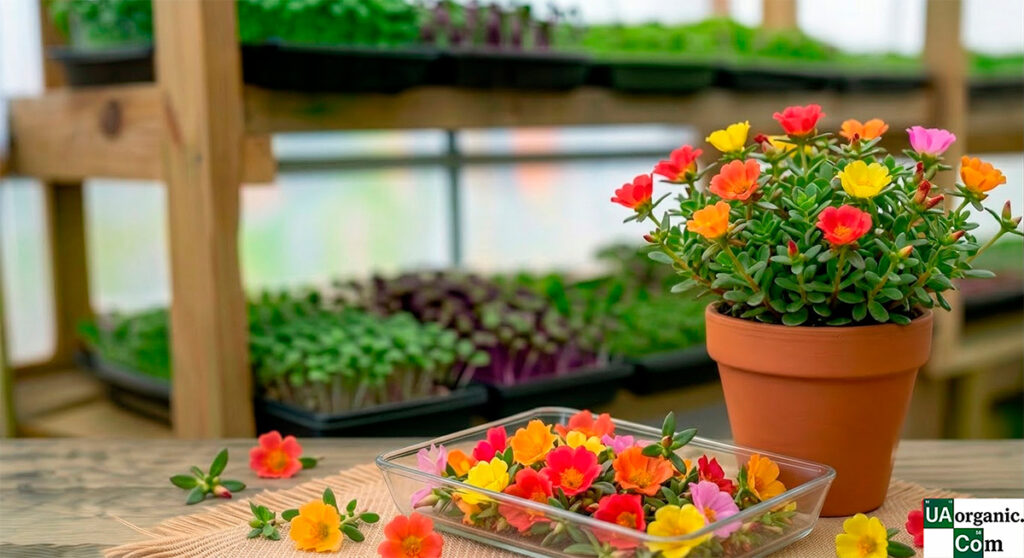
- ✅ Flowers are small yellow flowers, edible, mainly as a decoration
- ✅ The seeds are edible, they can be ground into flour or brewed
- ❌ Rough old stalks are tasteless, not used
Are all varieties edible: Portulaca oleracea — the main edible species. Attention: not to be confused with colostrum (Euphorbia spp.) is a toxic plant that looks similar and often grows nearby. Difference: milk thistle releases white milky juice when the stem is broken; Purslane is transparent. Decorative purslane (Portulaca grandiflora — moss rose) are also formally edible, but they are not grown for cooking and are practically not used in food.
Heat treatment: You can cook - unlike most edible flowers, purslane tolerates short heating well. The leaves are fried, stewed, blanched and added to soups. During cooking, a mucous substance is released - it is taken into account in the recipe.
- Contains oxalic acid (671–869 mg/100 g of fresh weight) — like spinach or rhubarb; people with sensitive kidneys should consume in moderation and not daily in large quantities
- Blanching or short-term boiling reduces the content of oxalates
- For most people, moderate consumption (like greens in a salad) is completely safe
- Allergy is rare; when using for the first time, start with a small amount
This information is general in nature and is not medical advice. Sources: USDA FoodData Central, EFSA.
Culinary use
Purslane is one of the few plants in the edible flower catalog where the leaves are more important than the flowers. These are full-fledged greens with a thousand-year culinary tradition: Greek salad with feta, Mexican verdolagas in salsa verde sauce, Moroccan shakshuka with purslane. The flowers are a small yellow decoration that is collected in the morning and lives for one day. But the leaves and stems are the main ingredient that replaces watercress, sorrel or baby spinach in dishes that require fresh acidity without aggressive bitterness.
Cheese in salad
washed and dried purslane is thrown into the salad without any processing. Young leaves and thin stems are eaten whole. Thicker stems are torn or cut.
Short blanching
the leaves are immersed in boiling salted water for 30–60 seconds, then immediately in ice water. The acidity softens, the mucous texture is weaker, oxalates are partially destroyed.
Stew
classics of Mexican and Mediterranean cuisine; the leaves are fried with garlic and tomatoes for 5–7 minutes; become soft, the mucus becomes a sauce thickener.
Pickling stems
young juicy stems are poured with apple or white wine vinegar with salt, sugar and spices. Stored in the refrigerator for weeks. Crispy spicy side dish.
Microgreens
purslane seeds germinate in 5–7 days; microgreens have a more concentrated flavor and, according to research, higher levels of antioxidants than the adult plant.
Fresh in dishes
young leaves and stems of purslane are used without any processing as a substitute for cresalate or sorrel; juicy, crispy and slightly sour.
- Don't collect purslane from cracks in the asphalt, along roads, or from cultivated lawns—even a nice-looking wild plant can be contaminated; only a proven food producer or own garden
- Do not confuse with colostrum (Euphorbia) — when the stem is broken, milk thistle releases white juice, purslane — transparent; this is the key difference
- Do not overcook - purslane needs a short 1-2 minutes to cook; long cooking turns it into a slimy, unappetizing mass
- Don't consume large amounts every day without interruption—as with spinach, moderation is a smart strategy because of the oxalate content
Perfect pairings
feta, ricotta, poached eggs, omelette - the acidity of purslane balances the creamy and salty base; a classic Mediterranean combination.
basic Mediterranean triad; purslane replaces or complements cresalate, adding juiciness and acidity without bitterness.
salmon, tuna, scallops, mussels - the fresh sourness of purslane contrasts with fatty or salty; especially good in carpaccio and tartare.
lemon vinaigrette, orange dressing - the acid of the dressing enhances the natural acidity of purslane and refreshes the dish.
stewed meat, hearty vegetable stews, soups - purslane thickens the broth with natural mucopolysaccharides and gives a delicate green note.
boiled lentils, beans, chickpeas - purslane leaves as a fresh sourness in warm bean dishes; replaces lemon juice or vinegar in the dressing.
How to select & store
- The leaves are juicy, elastic, dark green, without yellowing or wilting
- Stems are red or green-red, not woody
- The plant is no higher than 15–20 cm — the young stage is best for salads
- Without extraneous odors
Where to buy is important: Buy purslane only from proven producers, grown specifically for the food industry. Purslane grows everywhere - but this very availability is the trap: "wild" purslane from urban spaces is not suitable for consumption.
Freshness after cutting: 2–3 days
- Fresh purslane - airtight container or bag with a paper towel, refrigerator +4...+6°C, term 3–5 days
- Do not wash before use - moisture accelerates wilting
- Flowers — store separately, only for 1 day; to collect in the morning for a specific application
- For a restaurant: order leaves a few days in advance, flowers — on the day of delivery
Composition & properties
Purslane is one of the most well-studied edible plants in terms of nutritional composition. A special value is the exceptional concentration of omega-3 fatty acids among plants, which is rare for leafy vegetables.
| Nutrient | Value (per 100 g of fresh mass) |
|---|---|
| Caloric content | ~16 kcal |
| Omega-3 (α-linolenic acid) | ~300–400 mg is the highest figure among leafy vegetables |
| Vitamin A (β-carotene) | ~1320 IU (~44% of the daily norm) |
| Vitamin C (ascorbic acid) | ~21–27 mg |
| Vitamin E (α-tocopherol) | ~12.2 mg — 7 times more than in spinach |
| Potassium | ~494 mg |
| Magnesium | ~68 mg |
| Calcium | ~65 mg |
| iron | ~1.99 mg |
| Oxalic acid | ~671–869 mg (take into account for sensitive kidneys) |
| Glutathione | ~14.8 mg |
| Flavonoids and polyphenols | are present |
Purslane is a record holder among leafy vegetables for the content of plant-based omega-3 fatty acids. Research by Simopoulos & Salem (PubMed, 1992) showed that purslane is superior to spinach and most cultivated leafy vegetables in α-linolenic acid content. The University of Florida (IFAS Extension, 2024) confirms: 100 g of fresh purslane provides 81% of the daily requirement of vitamins A and E.
The content of vitamin E in purslane is 7 times higher than in spinach, according to a comparative study by Simopoulos (PubMed, 1992). The plant also contains glutathione, an antioxidant tripeptide that is rarely found in significant amounts in leafy vegetables.
Purslane microgreens surpass the adult plant in terms of antioxidant activity by ~24% — according to a study by Plocek et al. (2023).
Composition data: USDA FoodData Central; Uddin et al., PMC3934766; Simopoulos & Salem, PubMed 1354675; ScienceDirect 2020 (Petropoulos et al.). The information is general in nature and does not constitute medical advice.