When and how available
| the moon | Accessibility |
|---|---|
| January — April | ❌ Not the season |
| May | ✅ The first flowers with early sowing |
| June — August | ✅ Peak - abundant flowering, flowers every day |
| September | ✅ Flowering lasts until the first frost |
| October — December | ❌ Not the season |
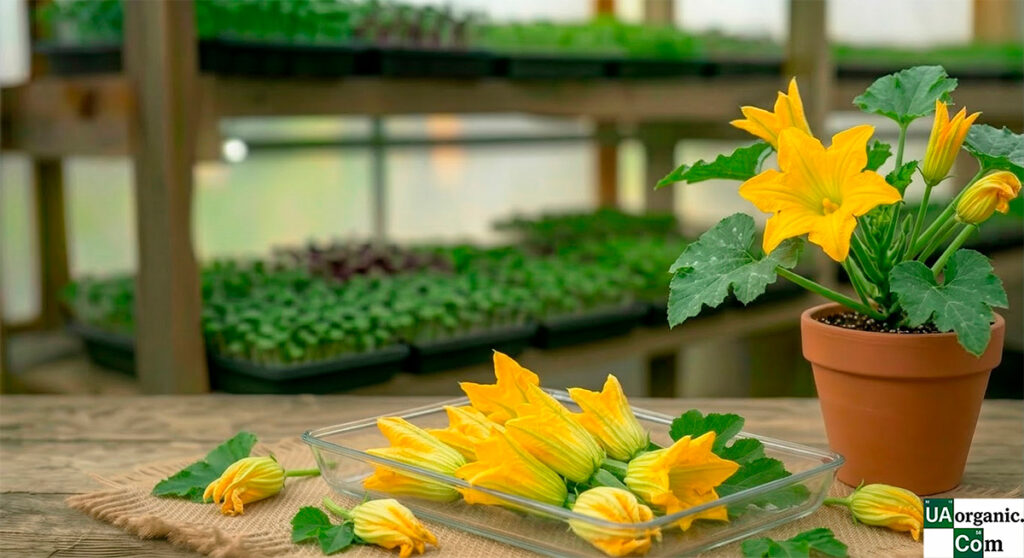
Zucchini and pumpkin plants bloom every day throughout the summer season. The plant produces many more male flowers than female—and it is the male flowers that are usually harvested for food. City farms can supply zucchini flowers in wider time frames when grown under controlled conditions.
| Form | Features of use |
|---|---|
| Fresh (male flower) | The main form is deep-frying, stuffing, soups; use on the day of collection |
| Fresh (female flower with fruit) | Stuffed with young zucchini is a delicacy; term 1 day |
| Blanched | For soups, pastes and stews; retains its shape after light blanching |
Taste, aroma & texture
Tender, slightly sweet, fresh - similar to a young zucchini, but more delicate. Raw petals have a light peppery note and herbal freshness without bitterness. When fried, the outer dough gives a crunch and a neutral background, while the middle remains juicy and soft with the same delicate vegetable taste. The filling (ricotta, anchovies, cheese, herbs) contrasts with the delicacy of the flower and is a full-fledged taste partner.
Gentle, fresh, herbal — without a floral or aromatic component. Similar to the aroma of freshly cut squash or pumpkin. It is not dominant and does not interrupt the other ingredients of the dish. When heated, it slightly intensifies — it becomes more "garden" and warm.
Petals are thin, silky and fragile when raw - they tear easily with rough handling. The flower is large (7–15 cm), which makes it a convenient container for filling: it is easy to put a full tablespoon of ricotta inside. After frying, the outer dough is crispy, the middle is juicy and soft. After blanching, it is tender and slightly slimy, like spinach.
Safety & edibility
Edible flowers are not the same as florist flowers. Only flowers grown specifically for food use without synthetic pesticides are suitable.
- ✅ The whole flower is complete - petals, stamen/pistil
- ✅ Male flowers are the main culinary form
- ✅ Female flowers are edible, but pick carefully (loss of fruit)
- ✅ The young fruit at the base of the female flower is edible together with the flower
- ❌ Flowers with any bitter taste are a sign of cucurbitsin, do not use
- ❌ Withered or darkened flowers - do not use
Are all varieties edible: Yes - all varieties Cucurbita pepo edibles, including zucchini, yellow squash, squash, and round pumpkins. Pumpkin flowers (C. maxima, C. moschata) are also edible — the taste and texture are similar, but the flowers can be larger and denser.
Heat treatment: Zucchini flowers can be eaten raw in salads, but they open best during heat treatment: frying, baking, stewing, soups. The raw flower is fragile and quickly withers after cooking - add it at the very end of stewed and boiled dishes.
- Cucurbicin is a natural bitter substance, which in rare cases can accumulate in domestic plants during reversion to the wild form or when crossing with decorative pumpkins. If the flower or fruit has a bitter taste, do not use it at all; cucurbicin is toxic in large doses
- Allergy to zucchini and pumpkins occurs; at first use for people with reactions to the Pumpkin family, start with a small amount
- Zucchini flower pollen can cause a reaction in people with pollen allergies
This information is general in nature and is not medical advice. Sources: USDA FoodData Central, EFSA.
Culinary use
Zucchini flowers are not a decoration or an aromatic additive. It is a vegetable ingredient that performs the function of a container or an independent component of a dish. The flower is large enough to hold a full filling and save it when frying or baking. Deep-fried, it turns into a self-sufficient dish. In soups and pastas - for a juicy vegetable component. The fact that the flower is also beautiful is a bonus, not the main goal.
Frying
the most popular and classic technique. The flower is stuffed or left empty, dipped in light liquid dough and fried in heated oil (175–180°C) for 2–3 minutes until golden. Serve immediately - the cooled flower loses its crunch. Dough: flour + water + salt (or flour + egg + carbonated water for a lighter version).
Stuffing and baking
the flower is opened, the stamen is removed (if desired), filled with stuffing and the edges are carefully closed. Sprinkle with olive oil, bake at 190–200°C for 12–15 minutes. Fillings: ricotta + herbs, goat cheese + honey, rice + minced meat.
Stew in dishes
flowers are added whole or coarsely chopped in the last 3–5 minutes of cooking soups, pastas, risottos. Heating softens the petals and gives the dish a delicate vegetable taste and a yellow tint.
Raw decor and salad
the petals are carefully opened and added to the salad or placed on the dish immediately before serving. Do not require any preparation, except for careful cleaning from insects.
Cleaning before use
the stamen is removed due to a possible excess of pollen (optional). The flowers are not washed under a stream - they are immersed in cool water for a few seconds and carefully dried or simply shaken.
Stuffing and serving raw
small flowers without heat treatment are stuffed with light ricotta and served as a cold appetizer; retains a crisp texture and fresh taste.
- Do not store flowers for more than one day - they wither almost instantly; plan a collection or order for a specific dish and cook on the day of receipt
- Do not sacrifice female flowers unnecessarily - it is better to collect male ones (a long stem without a mini-zucchini at the base) and leave female ones for fruiting
- Do not use flowers or fruits that have a bitter taste - even a barely perceptible bitterness is a signal of the presence of cucurbicin; it is better to throw away one plant than to risk it
- Do not fry in too cold oil - deep-fried flowers need a temperature of 175–180°C; a lower temperature leads to absorption of oil and decomposition of the dough
Perfect pairings
ricotta, cream cheese, mozzarella, mascarpone - a classic filling for stuffed flowers; the delicate cheese contrasts with the crispy dough, the delicate taste of the flower does not compete with the cheese.
the Roman tradition — an anchovy in the filling or between the flower and the dough gives a salty sharp contrast to the sweetish flower; one of the most effective flavor combinations in a simple kitchen.
basil, mint, parsley, thyme — in the filling or in the dough; floral tenderness and herbal freshness complement each other well.
flowers in a frittata, omelette or egg dishes - a fresh vegetable taste and a bright yellow-orange color in the egg base.
Mexican and Mediterranean tradition - flowers in sauce or in soup with tomatoes and garlic; the flavors are warm and rounded.
zucchini flowers as a stuffed side dish for chicken or veal; the delicate taste of the flower emphasizes the delicate profile of the white meat without dominating.
How to select & store
- The flower is fully opened or at the beginning of opening - bright yellow or yellow-orange color without darkening and fading
- Petals are elastic, without traces of mucus, mechanical damage and extraneous odors
- Check inside for insects - they often hide in the flower
- For filling - choose larger male flowers on a long stem
- Male vs. female: stem without thickening at the base - male; with a mini-zucchini - female
Buy zucchini flowers only from growers who grow them specifically for food use. In markets and supermarkets, you can often find flowers without chemical treatment from townspeople - but check. Flowers from your own garden are the best option if the plants have not been treated with pesticides.
Freshness after cutting: 2–3 days
- Fresh flowers - use on the day of collection; a maximum of 1 day in the refrigerator, standing upright in a glass of water or in a paper bag
- Do not wash before use - moisture accelerates fading; clean immediately before cooking
- Zucchini flowers do not fit for drying, freezing or candiing
Composition & properties
Zucchini flowers are a light and nutritious product with a noticeable content of trace elements. Like most flowers, they are consumed in relatively small quantities, but their nutrient profile is higher than most ornamental edible flowers due to their larger size and "vegetable" nature.
| Nutrient | Value (per 100 g of fresh flowers) |
|---|---|
| Water | ~94.5 g |
| Caloric content | ~16 kcal |
| Squirrel | ~1.6 g |
| Carbohydrates | ~2.4 g |
| Calcium | ~23 mg |
| Phosphorus | ~38 mg |
| iron | ~0.8 mg |
| Vitamin C | ~9 mg |
| Vitamin A (beta-carotene) | present |
| Potassium | ~247 mg |
Pumpkin flowers are one of the few edible flowers for which the USDA publishes a complete nutrient profile—thanks to their long culinary tradition in Mexico, where they have been part of the traditional diet of indigenous peoples for thousands of years.
The peoples of pre-Columbian Mesoamerica—the Aztecs, Mayans, and Toltecs—were eating pumpkin flowers long before pumpkins reached the Old World. Together with corn and beans, the pumpkin (and its flowers) were part of the "three sisters" - the basis of traditional farming and nutrition in Mesoamerica.
In Italy, zucchini flowers (fiori di zucca) appeared in culinary recipes at the end of the 16th and the beginning of the 17th centuries. after distribution Cucurbita pepo from the New World. Today they are an integral part of Roman cucina povera — the kitchens of the poor, where everything was eaten, including a flower.
Data: USDA FoodData Central. Values are given for fresh flowers of pumpkin plants (Cucurbita pepo).