
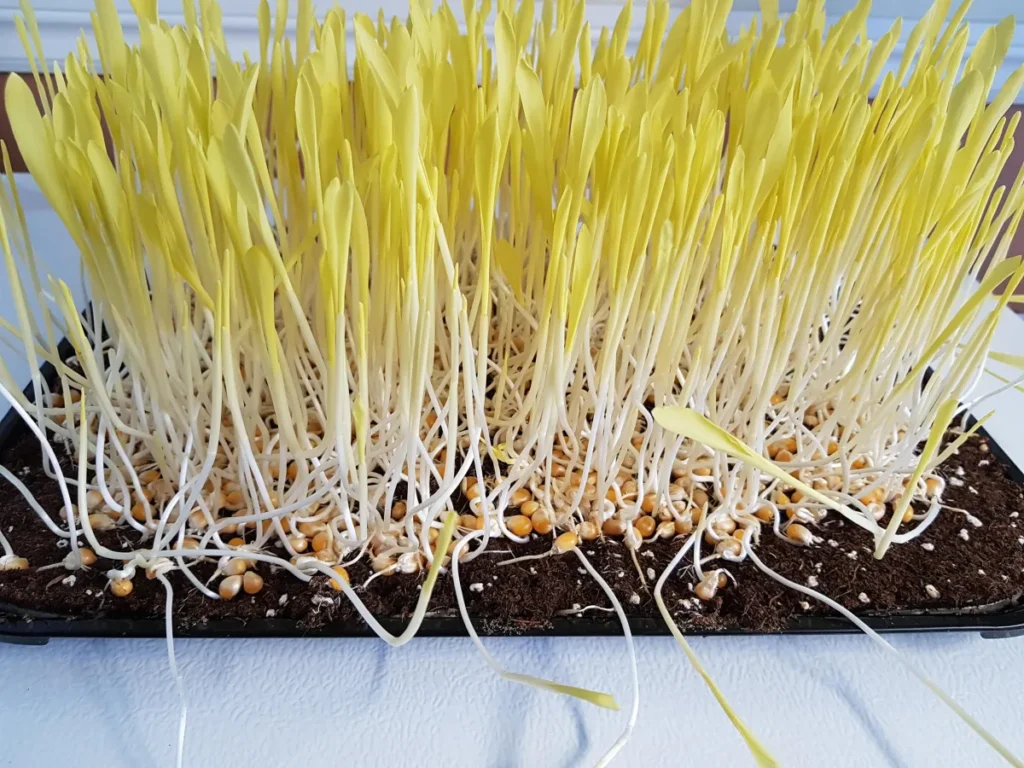
Flavor profile
Taste & aroma
Sweet, milky, fresh — Intensely sweet, milky, with a light corn caramel. A faint, sweet aroma.
Intensely sweet, milky, with a light corn caramel. No sharpness, no bitterness - completely "safe" greens in taste
Barely perceptible, sweet, cereal - it resembles boiled corn from afar, does not flavor the dish, it is more of a taste than a smell.
Tender, Soft, Juicy — probably the crispiest microgreens among all cultures. The stem is hard and elastic, it crunches loudly
Why flavor may vary batch to batch
The sweet taste of microgreen corn is formed thanks to the sugars that accumulate in the first days after germination. At bright light and a temperature of +20...+24°C sweetness is more pronounced. At low light the sprouts are pale and less tasty. Corn is one of the few cereals where an early cut (8-10 days) gives a sweeter taste than a late one.
Culinary use
How to use
Corn is a great culinary accent. Add fresh at the end of cooking or directly on the plate.
Spicy Asian dishes (Pad Thai, Thai curry)
a handful of yellow corn next to red chili and green cilantro: a contrast of colors and flavors that immediately catches the eye
Fruit salad
corn with mango, strawberry or orange. It is not surprising - it is a dessert. Yellow color and crunch make an ordinary fruit salad unexpected
Bowl with salmon and avocado
corn instead of corn kernels from a can: fresher, crisper, without preservatives
Gazpacho or cold soup
the yellow "brush" in the center of the red soup is impressive and unexpectedly tasty
Children's snack
instead of candy or sweet popcorn. Children like corn microgreens from the first time - sweet and crunchy
Decor of dark dishes
the bright yellow color on a black plate or dark sauce looks more impressive than most edible flowers
Perfect pairings
The sweetness of the corn contrasts sharply with the acidity of the tomatoes and the fattiness of the avocado
Sweet seafood accents are a classic of Asian cuisine
Sweet and sour dressings enhance the corn note - creamy sauces are neutral
- Do not leave in the light for longer than 30 minutes before serving: yellowed corn on the windowsill will turn green and bitter in 2-3 hours. Remove from the refrigerator immediately before serving.
- Do not subject to prolonged heat treatment: when heated for a long time, the crunch disappears, the sugar caramelizes and the taste becomes flat. You can throw it into a hot dish at the last moment - it will warm up, but you won't cook it.
- Do not mix with very bitter or spicy components: arugula, mustard, watercress will "destroy" the subtle sweetness of corn. She needs a neutral or sweet background.
Home storage
How to store
Corn keeps longer than most microgreens. Follow simple rules to keep it fresh for up to 3 weeks.
Don't cut more than you plan to eat right away. Store in refrigerator at +4...+6°C. No watering needed — natural moisture is enough.
Place in an open container or plate, cover with a damp paper towel. Don't seal — without air, greens yellow faster.
Don't wash until ready to eat. Wet greens spoil much faster. Rinse just before serving.
Nutrients & health
Benefits & composition
Corn is valued for its rich vitamin-mineral composition and bioactive compounds typical of microgreens.
Like most microgreens, corn contains a concentrated amount of nutrients relative to its weight — many times more than the mature plant.
| Protein | 3.5 g — building material for cells |
|---|---|
| Calories | ~30 kcal |
| Vitamins | E |
| Minerals | Potassium |
- To people who control blood sugar levels, it is worth taking into account the increased content of carbohydrates in corn microgreens compared to other greens and use it sparingly.
- Otherwise, corn microgreens have no specific limitations — they are well tolerated by sensitive stomachs and are suitable for children's menus.
This information is general in nature and is not medical advice. Composition data: USDA FoodData Central.
Worth knowing
vitamin E
Corn is a source of vitamin E, a fat-soluble antioxidant traditionally associated with skin condition and cell protection. The yellow color of sprouts is caused by **carotenoids** — pigments characteristic of yellow and orange plants.
natural sugars
It contains natural sugars in a form that is absorbed along with fiber - not as quickly as refined sugar. Suitable as part of a varied diet for those looking for a sweet taste in plant foods.
Antioxidants and biologically active substances
Microgreens are a concentrated source of antioxidants — compounds that are being studied in the context of protecting cells from oxidative stress. Regular consumption of a variety of microgreens is part of a balanced plant-based diet.
Antioxidants and biologically active substances
Microgreens are a concentrated source of antioxidants — compounds that are being studied in the context of protecting cells from oxidative stress. Regular consumption of a variety of microgreens is part of a balanced plant-based diet.



Corn: how to grow — step-by-step guide
Growing parameters, agronomy, common mistakesGrowing parameters
Large, hard (popcorn or sweet corn kernels)
Watering
- Water it 1-2 times a day (in the morning - necessarily, in the evening - if necessary)
- Lower watering (through a tray) is better; upper is permissible, but do not flood
- Corn drinks moderately - watch the weight of the tray
- A sign of lack: leaf plate becomes dull, loses turgor → water immediately
Storage
| Uncut in tray | Fridge +4...+6°C | up to 3 weeks |
|---|---|---|
| Cut in container | Refrigerator | up to 7 days |
| Room temperature | 1–2 days |
Harvest
The height of the sprouts is 8–12 cm, the stem is yellow, dense and juicy. The first leaf is just beginning to appear or has not yet appeared. Landmark - the stem has not yet "opened", it is tubular and keeps its shape. If the stem has started to open into a leaf, cut it immediately until it becomes rough.
Knife or scissors above the substrate. The stems are dense - they are easier to cut than tender greens. Cut quickly and immediately transfer to a closed container - minimum time under light.
Rinse in cold water, stirring slightly. Dry on a towel. Pack in an opaque or airtight container immediately after drying.
Seasonal adjustments
- Height: corn is heat-loving - it grows well in the heat, but soaking needs to be controlled
- Soaking: do only in the refrigerator, reduce to 8-10 hours - fermentation is faster with heat
- Mold: the risk increases; increase ventilation in the blackout zone
- Watering: moderate - moisture + heat provokes rotting in the root zone
- Cycle: can be shortened by 1-2 days - check readiness more often
- Heating: mandatory — at +16°C and below, corn grows slowly or does not sprout at all; a thermostat up to +24°C solves the problem
- Cycle: can extend up to 14 days - without heating in winter, the culture is unstable
- Soaking: when cold, extend to 14–16 hours for better swelling of the seeds
Water pH and EC
Optimal range for Corn: 6.0–7.5. Corn is not picky about pH and grows well in a neutral environment. The wide tolerance range makes it ideal for beginners with regular tap water.
Optimal range: 0.8–1.5 mS/cm. Moderate mineralization. High EC (>2.0) may manifest as brown leaf tips during long-term cultivation.
Experienced grower tips
Darkness is not "trying", but absolute
Make an opaque "room" for corn trays: a closet, a windowless room, a covered rack. Check for cracks. One uncovered shelf near the window — and the whole lot turns green overnight.
Soaking in the refrigerator = stable result
Cold water slows down microbial activity during soaking. The grains swell evenly without the risk of fermentation, even if "forgotten" for 14 hours instead of 12.
Ventilation — every day, even if the tray is closed
Ventilating the room reduces humidity in a dark space and significantly reduces the risk of mold on sugar-containing grains.
Cut in semi-darkness
To avoid even partial yellowing in the product batch, cut in minimal light and immediately pack in closed containers. The stem in bright light begins to darken after an hour.
Position as "Dessert Microgreens"
Corn is the only microgreen that looks organic in fruit salads and desserts. This opens up new sales segments: confectionery, children's facilities, restaurants with a healthy menu.
Agronomy notes and common mistakes
- Sowing: Soaked (8–12 h) corn — in one layer, seed to seed. A large size requires an even distribution.
- Clamp: 1–1.5 kg, 1–2 days. Easier clamping than for peas - the seeds are large enough for self-burial.
- Temperature: +20...+26°C. Corn is heat-loving — it grows slowly at +18°C; below +15°C — stops.
- Watering: 1-2 times a day. Good drainage is important — stagnant water under large seeds causes rotting.
- Ventilation: moderate Large corn sprouts are not susceptible to mold, but good circulation improves quality.
- Exposure to light → Sprouts turn green in 2-3 hours, the taste is bitter and fibrous → The entire cycle is in the dark — without exception
- Sowing in several layers → Mildew on the lower grains, rot → One dense layer — grains next to each other, but not on top of each other
- Fermentation during soaking → Sour smell, grains are slippery → Soak in cold water or refrigerator, no more than 12-14 hours
- Weak grip → The grains are pushed up together with the substrate → A pressure of 2 kg is necessarily the entire blackout
- Excess moisture → Mildew on the substrate, blackening of the stems → Moderate lower watering, the substrate dries out between waterings
- Thin substrate (<2 cm) → The roots come out from under the substrate, the grains are unstable → The layer of the substrate is at least 2 cm
Variety selection
Sweet corn
Pioneer, Dobrinya, Spirit
The most common choice for microgreens. Slightly sweet taste, even germination.
Fodder corn
Advisor, Odesa
A more neutral taste, but a greater yield of mass and a more even staircase. Suitable for mixes.
Що далі?
More crops in the catalog
Explore similar and contrasting flavors — from basil to amaranth