
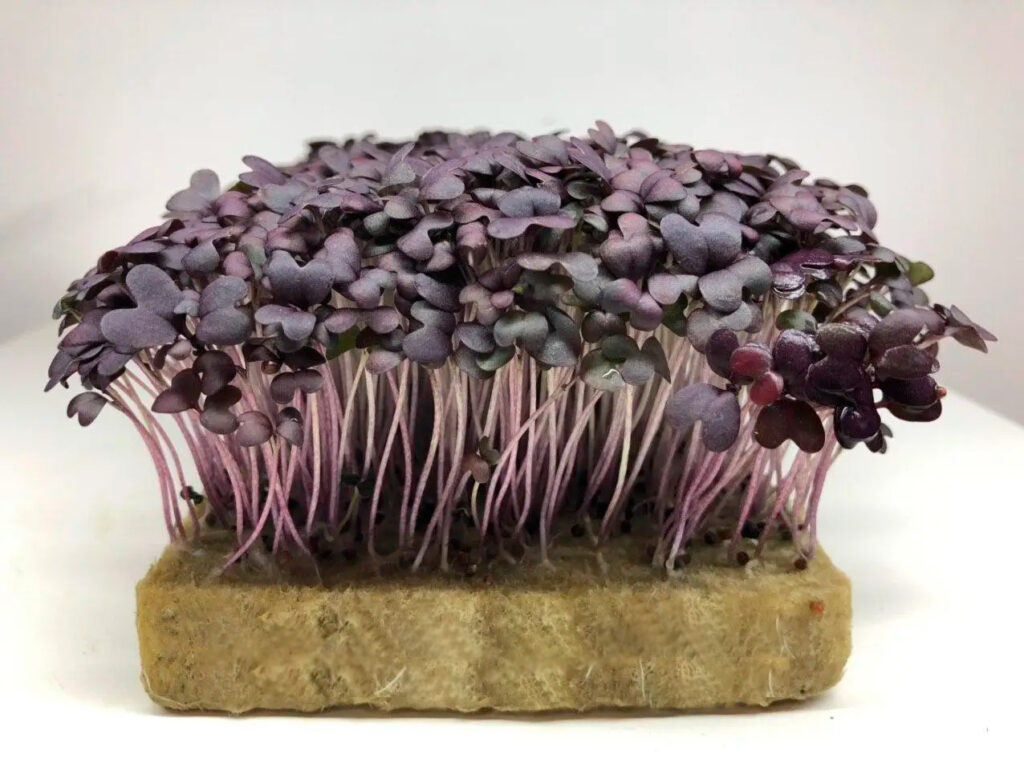
Flavor profile
Taste & aroma
Sharp, spicy, burning - with the same mustard character as its green sister, but somewhat softer and rounder. Fresh fragrance.
with the same mustard character as its green sister, but somewhat softer and rounder. There is no such "aggressive" burning that immediately hits the nose
Fresh, with distinct peppery notes of mustard oils. When the leaf is torn, the aroma is more intense. The dark color does not add earthiness - the aroma remains clean and spicy.
The leaves are slightly denser than those of green mustard. The lacy edge of the cotyledons and the first true leaves is the main decorative advantage of Carpet Red
Ripening and optimal harvest time
The cotyledons are opened, the color is still uneven, the sharpness is moderate.
Full pigmentation, the first carved leaf appears, sharpness and color at its peak — the optimal moment of collection.
The sharpness increases, the stem becomes harder, the color may fade.
Why flavor may vary batch to batch
The burgundy-red color of Carpet Red depends entirely on the intensity of the lighting. Anthocyanins, which give a dark color, are synthesized only under bright light. With weak lighting or dense sowing, the leaves remain green or acquire a dirty-brown shade - the batch loses its main advantage. This is the most important quality factor for this variety.
Culinary use
How to use
Mustard Carpet Red is a great culinary accent. Add fresh at the end of cooking or directly on the plate.
Meat cuts or charcuterie
burgundy microgreens between pieces of meat and cheese - looks more impressive than any parsley or dill
Beef carpaccio
a few stalks on top instead of a mix of greens — color and sharpness at the same time, without overloading the plate
Tartarus
Carpet Red as part of the side dish emphasizes the piquancy of the dish and adds visual depth
Burger or sandwich
between the cutlet and the bun — the dark color is visible even when assembled
Green salad
a handful of Carpet Red among arugula or spinach — a color accent and strengthening of the general spiciness
Canapes and tartlets
a burgundy leaf on top of white cheese or pate — minimal decor with maximum effect
Perfect pairings
Burgundy color on the background of pink meat or white cheese is a strong visual contrast
The dark color is especially effective on a plate with light sauces or horseradish cream
Several stems among the green microgreens give a color accent and increase the piquancy of the mix
- Do not add to hot dishes - the color fades from the temperature, and the sharpness evaporates
- Do not thicken when serving - the decorative effect is lost when there are too many leaves and they overlap each other
- Do not use as a neutral base - the spiciness is pronounced and in large quantities it dominates the rest of the flavors
Home storage
How to store
Mustard Carpet Red keeps longer than most microgreens. Follow simple rules to keep it fresh for up to 12–14 days.
Keep at +4...+6°C in the refrigerator. The term is up to 12–14 days. Cold preserves the color and turgor of this variety well.
Hermetic container at +4...+6°C. The term is up to 10–12 days. Carpet Red retains its marketable appearance after cutting longer than most leafy crops. Do not wash before use - moisture can slightly soften the color saturation of the leaves. ---
Don't wash until ready to eat. Wet greens spoil much faster. Rinse just before serving.
Pro tip: **A practical tip for the grower:** Carpet Red is a product for the HoReCa segment and gift sets. Position as a "decorative mustard for restaurant serving" and not just a hot green. This justifies the higher price compared to regular mustard with less output from the box.
Nutrients & health
Benefits & composition
Mustard Carpet Red is valued for its rich vitamin-mineral composition and bioactive compounds typical of microgreens.
Like most microgreens, mustard carpet red contains a concentrated amount of nutrients relative to its weight — many times more than the mature plant.
| Protein | 2.8 g — building material for cells |
|---|---|
| Calories | ~32 kcal |
| Vitamins | K |
| Minerals | Calcium, Magnesium, Potassium, Iron |
- People with high acidity of the stomach or a sensitive stomach should use it sparingly - mustard oils stimulate the production of gastric juice.
- Children of preschool and primary school age are usually too acute.
- People taking blood thinners should consider their overall intake of vitamin K-rich greens.
This information is general in nature and is not medical advice. Composition data: USDA FoodData Central.
Worth knowing
Carpet Red contains
Carpet Red contains the same isothiocyanates as mustard greens—natural mustard oils traditionally considered antibacterial compounds and digestive stimulants. In addition, anthocyanins, polyphenols, which are synthesized in response to intense lighting. These pigments are traditionally included in the diet as part of antioxidant nutrition.
Culture is the source
The culture is a source of vitamin K, and also contains folic acid, a nutrient that is traditionally included in the diet during increased physical activity and during certain physiological periods.
Antioxidants and biologically active substances
Microgreens are a concentrated source of antioxidants — compounds that are being studied in the context of protecting cells from oxidative stress. Regular consumption of a variety of microgreens is part of a balanced plant-based diet.
Antioxidants and biologically active substances
Microgreens are a concentrated source of antioxidants — compounds that are being studied in the context of protecting cells from oxidative stress. Regular consumption of a variety of microgreens is part of a balanced plant-based diet.
Similar crops
Similar by taste microgreens
If you are looking to complement or replace Mustard Carpet Red:
Mustard Carpet Red: how to grow — step-by-step guide
Growing parameters, agronomy, common mistakesGrowing parameters
Small, round, red-brown
Step-by-step guide
Seed preparation
Carpet Red is not soaked. The seeds are small and germinate well without pretreatment.
Sowing
- Moisten the substrate evenly.
- Spread the seeds evenly. The norm of 3 g — aim for an even distribution without overlaps. Thickened sowing (more than 4 g) will give a green or variegated batch due to mutual shading.
- After sowing, sprinkle the surface abundantly with water from a spray bottle.
Carpet Red and Green Mustard look good in a mix — one box of each variety, cut together. The burgundy and green colors contrast, and the taste remains in a single mustard profile. Such a mix is easier to sell than each variety separately.
Clamp — 1–2 kg
Clamping is needed for quick ingrowth of roots into the substrate and straight stems. Without clamping, part of the sprouts remains "hanging" - the stems are uneven and tend to lie down.
Rate: 1–2 kg. A little heavier pressing than for mustard green - the stem of Carpet Red is a little thinner and needs a better fixation of the root.
Darkness (Blackout) — 3–4 days
Conditions:
- Complete darkness: cover with a second box or move to a dark place
- Temperature: +18...+22°C. Above +24°C, the stem stretches and weakens
- Watering is moderate, lower
On the 2nd or 3rd day, white fluff will appear on the roots - root hairs, not mold. Check: spray with water - root hairs will disappear, mold will remain.
A sign of readiness: the sprouts confidently raised the clamp, height 3–4 cm, yellow-cream color.
Vegetation in the light — 5–7 days
This is a crucial stage for Carpet Red. Everything is formed here, for which this variety is valued - the burgundy-red color of the leaves.
Lighting is the main factor: anthocyanins are synthesized only with sufficient light intensity. Pigmentation begins to appear on the 2nd-3rd day of vegetation. If after 4 days the leaves remain green or variegated, the intensity is not enough. LED lamps with a blue-red spectrum give a better result. Lighting duration: 16 hours per day.
It is important about the density of sowing: even with sufficient external lighting, with dense sowing, the lower leaves are shaded by the upper layer - they remain green. That is why the norm of 3 g is critical.
Watering: moderate, lower. Overflow during the growing season provokes a "black leg" - especially with poor ventilation, to which red varieties are more sensitive than green ones.
Ventilation: mandatory With stagnation of moist air, Carpet Red picks up "black leg" faster than green mustard. Ventilate the room daily.
For the first 2-3 days in the light, keep the boxes as close as possible to the lamp. A shock dose of the blue spectrum at the start accelerates the accumulation of anthocyanins and gives a more saturated uniform color. After the appearance of a stable burgundy shade, it can be moved to a standard distance.
Watering
- Water it 1-2 times a day (in the morning - necessarily, in the evening - if necessary)
- Lower watering is better — preserves the rich purple color of the leaves
- Similar to mustard green in needs, but grows a little slower
- A sign of lack: the purple color fades, the leaves curl slightly → water
Storage
| Uncut in tray | Fridge +4...+6°C | up to 3 weeks |
|---|---|---|
| Cut in container | Refrigerator | up to 7 days |
| Room temperature | 1–2 days |
Harvest
- The cotyledons are fully opened, the color is saturated and uniform throughout the box
- The first real leaf with a characteristic carved edge has appeared - it is this that gives Carpet Red its decorative recognition
- The aroma of mustard oils is palpable to the touch
Sharp knife under the root. A clean cut is important—moisture on the cut accelerates decomposition.
Rinse in cold water just before serving. Dry with a paper towel without excessive pressure - the leaves are delicate and the lacy edge crumples easily.
Seasonal adjustments
- Soaking: reduce by 2–3 hours from the standard - the seeds are active in the heat
- Ventilation: open more often in the blackout phase to avoid excess moisture
- Watering: increase the frequency - the substrate dries faster at a higher temperature
- Expect: shortening of the cycle by 2–3 days, a more tender stem
- Soaking: increase by 2-3 hours from the standard - cold water is absorbed more slowly
- Placement: keep the trays in a warmer place (next to the battery, but not close to it)
- Watering: use water at room temperature—cold slows growth
- Expect: lengthening the cycle by 2-4 days, denser and more fragrant result
Water pH and EC
The optimal range for Mustard Carpet Red: 6.0–7.0. Similarly to green mustard, a weakly acidic-neutral environment is optimal. Carpet Red anthocyanin pigments are more stable at lower pH.
Optimal range: 1.0–2.0 mS/cm. The parameters are identical to green mustard. The color of Carpet Red does not depend on the mineralization of the water.
Experienced grower tips
Carpet Red and Mustard Green is a natural commercial mix
The same agricultural equipment, the same cycle, different color. It is convenient to grow together, it is profitable to sell together - the mix is more expensive than each culture separately.
The first days under the lamp are crucial for color
Anthocyanins accumulate actively at the beginning of the growing season. Do not skimp on lighting in the first 2-3 days after leaving the dark - this is where the final color saturation is established.
Thinner seeding = better color = higher price
3 g instead of 5 g - a smaller yield, but a uniformly colored premium product. It is the right choice for the restaurant segment.
Ventilation is more critical than for mustard greens
Red varieties of cabbage are more prone to "black leg" with stagnant air. If you have a closed room without circulation, add a fan or open the door more often.
The first carved leaf is a marketing advantage
Carpet Red, cut at the stage of the first real leaves, looks much more spectacular than at the stage of cotyledons. A little longer growth — significantly higher decorative value.
Agronomy notes and common mistakes
- Sowing: No soaking. High density. Even distribution is more important than for mustard greens — an uneven canopy masks a variety of colors.
- Clamp: Light or no pressure.
- Temperature: +18...+24°C. Coolness (+16°C) intensifies the purple color — a beneficial effect.
- Watering: 1-2 times a day. Similar to green mustard.
- Ventilation: It is important. Prevention of "black leg".
- Thickened sowing (more than 4 g) → The leaves are green or variegated, the color is uneven → Observe the norm of 3 g — it is impossible to correct when thickened
- Weak lighting → Leaves are green or dirty brown instead of maroon → Increase the intensity, bring the boxes closer to the lamp, check the duration (16 h/day)
- Poor ventilation → "Black leg" — rotting of the stem at the base → Ventilate the room daily, avoid stagnation of moist air
- Panic over white fluff → Grover throws out a healthy batch → Spray with water: root hairs will disappear, mold will not
- Overflow on vegetation → Laying of stems, rotting at the base → Watering is moderate, lower; do not overfill the tray
- Late cut → The sharpness increases sharply, the stem becomes harder → Cut when the first carved leaf appears, do not delay
Variety selection
Carpet Red Mustard
Brassica juncea Red
Profile variety — red-purple leaves with a spicy profile. Decorative and tasty at the same time.
Spicy mustard mixture
Mizuna Red, Red Giant
A similar decorative effect, but a slightly milder burning sensation. Suitable for mixes.
Що далі?
More crops in the catalog
Explore similar and contrasting flavors — from basil to amaranth